§ 11. Invertibility and Isomorphisms¶
Inverse of Linear Transformation¶
Definition 11.1 : Inverse of a Linear Transformation
Let \(V\) and \(W\) be vector spaces, and let \(T: V \rightarrow W\) be linear. A function \(U: W \rightarrow V\) is said to be an inverse of \(T\) if \(TU=I_{W}\) and \(UT=I_{V}\). If \(T\) has an inverse, then \(T\) is said to be invertible.
If \(T\) is invertible, then the inverse of \(T\) is unique and is denoted by \(T^{-1}\).
Concept 11.2 : Properties of invertible transformations
The following facts hold for invertible functions \(T\) and \(U\).
- \((TU)^{-1}=U^{-1} T^{-1}\).
- \(\left(T^{-1}\right)^{-1}=T\); in particular, \(T^{-1}\) is invertible.
We often use the fact that a function is invertible if and only if it is both one-to-one and onto. We can therefore restate Theorem 8.15 as follows.
- Let \(T: V \rightarrow W\) be a linear transformation, where \(V\) and \(W\) are finite-dimensional spaces of equal dimension. Then \(T\) is invertible if and only if \(\operatorname{rank}(T)=\operatorname{dim}(V)\).
Theorem 11.3 : Inverse of an invertible linear transformation is linear.
Let \(V\) and \(W\) be vector spaces, and let \(T: V \rightarrow W\) be linear and invertible. Then \(T^{-1}: W \rightarrow V\) is linear.
Proof
Let \(y_{1}, y_{2} \in W\) and \(c \in F\). Since \(T\) is onto and one-to-one, there exist unique vectors \(x_{1}\) and \(x_{2}\) such that \(T\left(x_{1}\right)=y_{1}\) and \(T\left(x_{2}\right)=y_{2}\). Thus \(x_{1}=T^{-1}\left(y_{1}\right)\) and \(x_{2}=T^{-1}\left(y_{2}\right)\); so
Inverse of a Matrix and its Analogy with the Inverse of Linear Transformation¶
Definition 11.4 : Invertible Matrix, Inverse of a Matrix
Let \(A\) be an \(n \times n\) matrix. Then \(A\) is invertible if there exists an \(n \times n\) matrix \(B\) such that \(AB=BA=I\).
If \(A\) is invertible, then the matrix \(B\) such that \(A B=B A=I\) is unique. (If \(C\) were another such matrix, then \(C=C I=C(A B)=(C A) B=I B=B\).) The matrix \(B\) is called the inverse of \(A\) and is denoted by \(A^{-1}\).
Theorem 11.5 : Invertible linear transformations preserve dimension.
Let \(T\) be an invertible linear transformation from \(V\) to \(W\). Then \(V\) is finite-dimensional if and only if \(W\) is finite-dimensional. In this case, \(\operatorname{dim}(V)=\operatorname{dim}(W)\).
Proof
Suppose that \(V\) is finite-dimensional. Let \(\beta=\left\{x_{1}, x_{2}, \ldots, x_{n}\right\}\) be a basis for \(V\). By Theorem 8.11, \(T(\beta)\) spans \(R(T)=W\); hence \(W\) is finite-dimensional by Theorem 6.3. Conversely, if \(W\) is finite-dimensional, then so is \(V\) by a similar argument, using \(T^{-1}\).
Now suppose that \(V\) and \(W\) are finite-dimensional. Because \(T\) is one-to-one and onto, we have
So by Theorem 8.13, it follows that \(\operatorname{dim}(V)=\operatorname{dim}(W)\).
Theorem 11.6 : Invertibility corresponds to invertibility of the matrix representation.
Let \(V\) and \(W\) be finite-dimensional vector spaces with ordered bases \(\beta\) and \(\gamma\), respectively. Let \(T: V \rightarrow W\) be linear. Then \(T\) is invertible if and only if \([T]_{\beta}^{\gamma}\) is invertible. Furthermore,
Proof
Suppose that \(T\) is invertible. By Theorem 11.5, we have \(\operatorname{dim}(V)=\operatorname{dim}(W)\). Let \(n=\operatorname{dim}(V)\). So \([T]_{\beta}^{\gamma}\) is an \(n \times n\) matrix. Now \(T^{-1}: W \rightarrow V\) satisfies \(TT^{-1}=I_{W}\) and \(T^{-1}T=I_{V}\). Thus
Similarly, \([T]_{\beta}^{\gamma}\left[T^{-1}\right]_{\gamma}^{\beta}=I_{n}\). So \([T]_{\beta}^{\gamma}\) is invertible and \(\left([T]_{\beta}^{\gamma}\right)^{-1}=\left[T^{-1}\right]_{\gamma}^{\beta}\).
Now suppose that \(A=[T]_{\beta}^{\gamma}\) is invertible. Then there exists an \(n \times n\) matrix \(B\) such that \(AB=BA=I_{n}\). By Theorem 8.17, there exists \(U \in \mathcal{L}(W, V)\) such that
where \(\gamma=\left\{w_{1}, w_{2}, \ldots, w_{n}\right\}\) and \(\beta=\left\{v_{1}, v_{2}, \ldots, v_{n}\right\}\). It follows that \([U]_{\gamma}^{\beta}=B\). To show that \(U=T^{-1}\), observe that
by Theorem 10.6. So \(UT=I_{V}\), and similarly, \(TU=I_{W}\).
Corollary 11.7 : Invertibility in \(\mathcal{L}(V)\) corresponds to invertibility of the representing matrix.
Let \(V\) be a finite-dimensional vector space with an ordered basis \(\beta\), and let \(T: V \rightarrow V\) be linear. Then \(T\) is invertible if and only if \([T]_{\beta}\) is invertible. Furthermore,
Proof
Apply Theorem 11.6 with \(W=V\) and \(\gamma=\beta\).
Corollary 11.8 : Invertibility of a matrix corresponds to invertibility of \(L_A\).
Let \(A\) be an \(n \times n\) matrix. Then \(A\) is invertible if and only if \(L_{A}\) is invertible. Furthermore,
Proof
Let \(\beta\) be the standard ordered basis for \(F^{n}\). By Theorem 10.16(a), \([L_{A}]_{\beta}=A\). Applying Corollary 11.7 to the linear transformation \(L_{A}: F^{n} \rightarrow F^{n}\), we see that \(L_{A}\) is invertible if and only if \(A\) is invertible.
If \(A\) is invertible, then by Corollary 11.7,
By Theorem 10.16(d), \(\left(L_{A}\right)^{-1}=L_{C}\), where \(C=\left[\left(L_{A}\right)^{-1}\right]_{\beta}\). Hence \(\left(L_{A}\right)^{-1}=L_{A^{-1}}\).
Isomorphism¶
Definition 11.9 : Isomorphism
Let \(V\) and \(W\) be vector spaces. We say that \(V\) is isomorphic to \(W\) if there exists a linear transformation \(T: V \rightarrow W\) that is invertible. Such a linear transformation is called an isomorphism from \(V\) onto \(W\).
Theorem 11.10 : Isomorphism is an equivalence relation.
The relation "is isomorphic to" is an equivalence relation on the class of vector spaces over a fixed field.
Proof
Let \(F\) be a field, and consider vector spaces over \(F\).
-
Reflexive.
For any vector space \(V\) over \(F\), the identity transformation \(I_{V}: V \rightarrow V\) is linear and invertible (with inverse \(I_{V}\)). Hence \(V\) is isomorphic to \(V\). -
Symmetric.
Suppose that \(V\) is isomorphic to \(W\). Then there exists a linear invertible transformation \(T: V \rightarrow W\). By Theorem 11.3, \(T^{-1}: W \rightarrow V\) is linear, and clearly \(T^{-1}\) is invertible. Hence \(W\) is isomorphic to \(V\). -
Transitive.
Suppose that \(V\) is isomorphic to \(W\) and that \(W\) is isomorphic to \(Z\). Let \(T: V \rightarrow W\) and \(U: W \rightarrow Z\) be isomorphisms. By Theorem 10.1, \(UT: V \rightarrow Z\) is linear. Also, \(UT\) is invertible with inverse \(T^{-1}U^{-1}\) by Concept 11.2. Hence \(V\) is isomorphic to \(Z\).
So we need only say that \(V\) and \(W\) are isomorphic.
Theorem 11.11 : Finite-dimensional vector spaces are isomorphic if and only if they have the same dimension.
Let \(V\) and \(W\) be finite-dimensional vector spaces (over the same field). Then \(V\) is isomorphic to \(W\) if and only if \(\operatorname{dim}(V)=\operatorname{dim}(W)\).
Proof
Suppose that \(V\) is isomorphic to \(W\) and that \(T: V \rightarrow W\) is an isomorphism from \(V\) to \(W\). By Theorem 11.5, we have that \(\operatorname{dim}(V)=\operatorname{dim}(W)\).
Now suppose that \(\operatorname{dim}(V)=\operatorname{dim}(W)\), and let \(\beta=\left\{v_{1}, v_{2}, \ldots, v_{n}\right\}\) and \(\gamma=\left\{w_{1}, w_{2}, \ldots, w_{n}\right\}\) be bases for \(V\) and \(W\), respectively. By Theorem 8.17, there exists \(T: V \rightarrow W\) such that \(T\) is linear and \(T\left(v_{i}\right)=w_{i}\) for \(i=1,2, \ldots, n\). Using Theorem 8.11, we have
So \(T\) is onto. From Theorem 8.15, we have that \(T\) is also one-to-one. Hence \(T\) is an isomorphism.
Corollary 11.12 : An \(n\)-dimensional vector space is isomorphic to \(F^n\).
Let \(V\) be a vector space over \(F\). Then \(V\) is isomorphic to \(F^{n}\) if and only if \(\operatorname{dim}(V)=n\).
Theorem 11.13 : Matrix representation is an isomorphism from \(\mathcal{L}(V, W)\) to \(\mathrm{M}_{m \times n}(F)\).
Let \(V\) and \(W\) be finite-dimensional vector spaces over \(F\) of dimensions \(n\) and \(m\), respectively, and let \(\beta\) and \(\gamma\) be ordered bases for \(V\) and \(W\), respectively. Then the function \(\Phi: \mathcal{L}(V, W) \rightarrow \mathrm{M}_{m \times n}(F)\), defined by \(\Phi(T)=[T]_{\beta}^{\gamma}\) for \(T \in \mathcal{L}(V, W)\), is an isomorphism.
Proof
By Theorem 9.10, \(\Phi\) is linear. Hence we must show that \(\Phi\) is one-to-one and onto. This is accomplished if we show that for every \(m \times n\) matrix \(A\), there exists a unique linear transformation \(T: V \rightarrow W\) such that \(\Phi(T)=A\). Let \(\beta=\left\{v_{1}, v_{2}, \ldots, v_{n}\right\}\), \(\gamma=\left\{w_{1}, w_{2}, \ldots, w_{m}\right\}\), and let \(A\) be a given \(m \times n\) matrix. By Theorem 8.17, there exists a unique linear transformation \(T: V \rightarrow W\) such that
But this means that \([T]_{\beta}^{\gamma}=A\), or \(\Phi(T)=A\). Thus \(\Phi\) is an isomorphism.
Corollary 11.14 : Dimension of \(\mathcal{L}(V, W)\)
Let \(V\) and \(W\) be finite-dimensional vector spaces of dimensions \(n\) and \(m\), respectively. Then \(\mathcal{L}(V, W)\) is finite-dimensional of dimension \(mn\).
Proof
The proof follows from Theorem 11.13 and Theorem 11.11 and the fact that \(\operatorname{dim}\left(\mathrm{M}_{m \times n}(F)\right)=mn\).
Definition 11.15 : Standard Representation
Let \(\beta\) be an ordered basis for an \(n\)-dimensional vector space \(V\) over the field \(F\). The standard representation of \(V\) with respect to \(\beta\) is the function \(\phi_{\beta}: V \rightarrow F^{n}\) defined by \(\phi_{\beta}(x)=[x]_{\beta}\) for each \(x \in V\).
Theorem 11.16 : Standard representation is an isomorphism.
For any finite-dimensional vector space \(V\) with ordered basis \(\beta\), \(\phi_{\beta}\) is an isomorphism.
Proof
Let \(\beta=\left\{v_{1}, v_{2}, \ldots, v_{n}\right\}\). For any \(x, y \in V\) and \(a \in F\), we have
hence \(\phi_{\beta}\) is linear.
Let \(\left(\begin{array}{c} a_{1} \\ a_{2} \\ \vdots \\ a_{n} \end{array}\right) \in F^{n}\). Set \(x=\sum_{i=1}^{n} a_{i} v_{i}\). Then \([x]_{\beta}=\left(\begin{array}{c} a_{1} \\ a_{2} \\ \vdots \\ a_{n} \end{array}\right)\), so \(\phi_{\beta}\) is onto.
If \(\phi_{\beta}(x)=\phi_{\beta}(y)\), then \([x]_{\beta}=[y]_{\beta}\), so \(x=y\) by uniqueness of coordinates with respect to the basis \(\beta\). Therefore \(\phi_{\beta}\) is one-to-one, and hence an isomorphism.
Corollary 11.17 : An \(n\)-dimensional vector space is isomorphic to \(F^n\). (revisited)
Let \(V\) be an \(n\)-dimensional vector space over \(F\). Then \(V\) is isomorphic to \(F^{n}\).
Proof
Let \(\beta\) be an ordered basis for \(V\). By Theorem 11.16, \(\phi_{\beta}: V \rightarrow F^{n}\) is an isomorphism.
This provides us with an alternate proof of Corollary 11.12.
Concept 11.18 : Relationship between \(T\) and \(L_{[T]_{\beta}^{\gamma}}\)
Let \(V\) and \(W\) be vector spaces of dimension \(n\) and \(m\), respectively, and let \(T: V \rightarrow W\) be a linear transformation. Define \(A=[T]_{\beta}^{\gamma}\), where \(\beta\) and \(\gamma\) are arbitrary ordered bases of \(V\) and \(W\), respectively. We are now able to use \(\phi_{\beta}\) and \(\phi_{\gamma}\) to study the relationship between the linear transformations \(T\) and \(L_{A}: F^{n} \rightarrow F^{m}\).
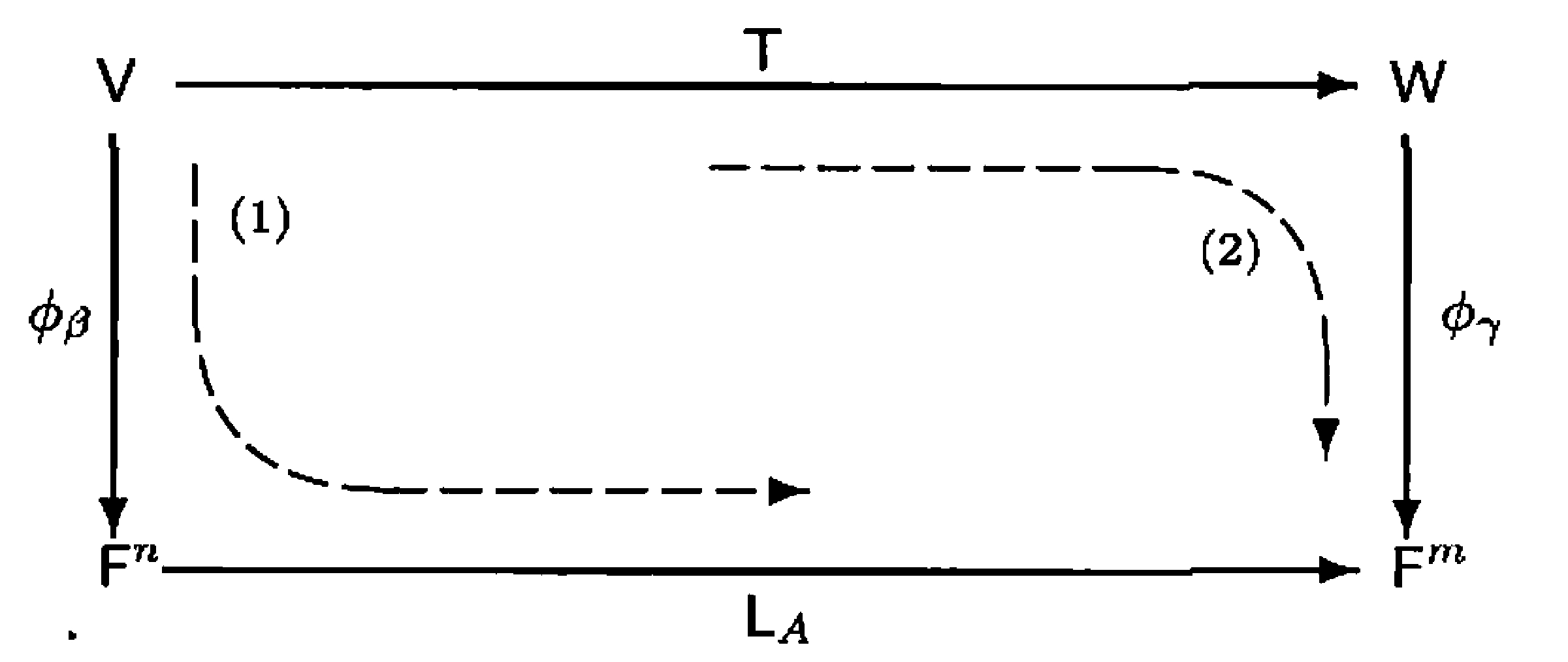
Figure 11.1.
Let us first consider Figure 11.1. Notice that there are two composites of linear transformations that map \(V\) into \(F^{m}\):
- Map \(V\) into \(F^{n}\) with \(\phi_{\beta}\) and follow this transformation with \(L_{A}\); this yields the composite \(L_{A} \phi_{\beta}\).
- Map \(V\) into \(W\) with \(T\) and follow it by \(\phi_{\gamma}\) to obtain the composite \(\phi_{\gamma} T\).
These two composites are depicted by the dashed arrows in Figure 11.1. By a simple reformulation of Theorem 10.14, we may conclude that
that is, the diagram "commutes." Heuristically, this relationship indicates that after \(V\) and \(W\) are identified with \(F^{n}\) and \(F^{m}\) via \(\phi_{\beta}\) and \(\phi_{\gamma}\), respectively, we may "identify" \(T\) with \(L_{A}\). This diagram allows us to transfer operations on abstract vector spaces to ones on \(F^{n}\) and \(F^{m}\).
Exercise¶
Exercise 11.4
Let \(A\) and \(B\) be \(n \times n\) invertible matrices. Prove that \(AB\) is invertible and \((AB)^{-1}=B^{-1} A^{-1}\).
Exercise 11.5
Let \(A\) be invertible. Prove that \(A^{t}\) is invertible and \(\left(A^{t}\right)^{-1}=\left(A^{-1}\right)^{t}\).
Exercise 11.9
Let \(A\) and \(B\) be \(n \times n\) matrices such that \(AB\) is invertible. Prove that \(A\) and \(B\) are invertible. Give an example to show that arbitrary matrices \(A\) and \(B\) need not be invertible if \(AB\) is invertible.
Exercise 11.10
Let \(A\) and \(B\) be \(n \times n\) matrices such that \(AB=I_{n}\).
- (a) Use Exercise 11.9 to conclude that \(A\) and \(B\) are invertible.
- (b) Prove \(A=B^{-1}\) (and hence \(B=A^{-1}\)). (We are, in effect, saying that for square matrices, a "one-sided" inverse is a "two-sided" inverse.)
- (c) State and prove analogous results for linear transformations defined on finite-dimensional vector spaces.
Exercise 11.15
Let \(V\) and \(W\) be \(n\)-dimensional vector spaces, and let \(T: V \rightarrow W\) be a linear transformation. Suppose that \(\beta\) is a basis for \(V\). Prove that \(T\) is an isomorphism if and only if \(T(\beta)\) is a basis for \(W\).
Exercise 11.17
Let \(V\) and \(W\) be finite-dimensional vector spaces and \(T: V \rightarrow W\) be an isomorphism. Let \(V_{0}\) be a subspace of \(V\).
- (a) Prove that \(T\left(V_{0}\right)\) is a subspace of \(W\).
- (b) Prove that \(\operatorname{dim}\left(V_{0}\right)=\operatorname{dim}\left(T\left(V_{0}\right)\right)\).
Exercise 11.20
Let \(T: V \rightarrow W\) be a linear transformation from an \(n\)-dimensional vector space \(V\) to an \(m\)-dimensional vector space \(W\). Let \(\beta\) and \(\gamma\) be ordered bases for \(V\) and \(W\), respectively. Prove that \(\operatorname{rank}(T)=\operatorname{rank}\left(L_{A}\right)\) and that \(\operatorname{nullity}(T)=\operatorname{nullity}\left(L_{A}\right)\), where \(A=[T]_{\beta}^{\gamma}\).
Hint: Apply Exercise 11.17 to Concept 11.18.
Exercise 11.22
Let \(c_{0}, c_{1}, \ldots, c_{n}\) be distinct scalars from an infinite field \(F\). Define \(T: \mathrm{P}_{n}(F) \rightarrow F^{n+1}\) by \(T(f)=\left(f\left(c_{0}\right), f\left(c_{1}\right), \ldots, f\left(c_{n}\right)\right)\). Prove that \(T\) is an isomorphism.
Hint: Use the Lagrange polynomials associated with \(c_{0}, c_{1}, \ldots, c_{n}\).
Exercise 11.24
Let \(T: V \rightarrow Z\) be a linear transformation of a vector space \(V\) onto a vector space \(Z\). Define the mapping
for any coset \(v+N(T)\) in \(V / N(T)\).
- (a) Prove that \(\overline{T}\) is well-defined; that is, prove that if \(v+N(T)=v^{\prime}+N(T)\), then \(T(v)=T\left(v^{\prime}\right)\).
- (b) Prove that \(\overline{T}\) is linear.
- (c) Prove that \(\overline{T}\) is an isomorphism.
- (d) Prove that the diagram shown below commutes; that is, prove that \(T=\overline{T} \eta\).
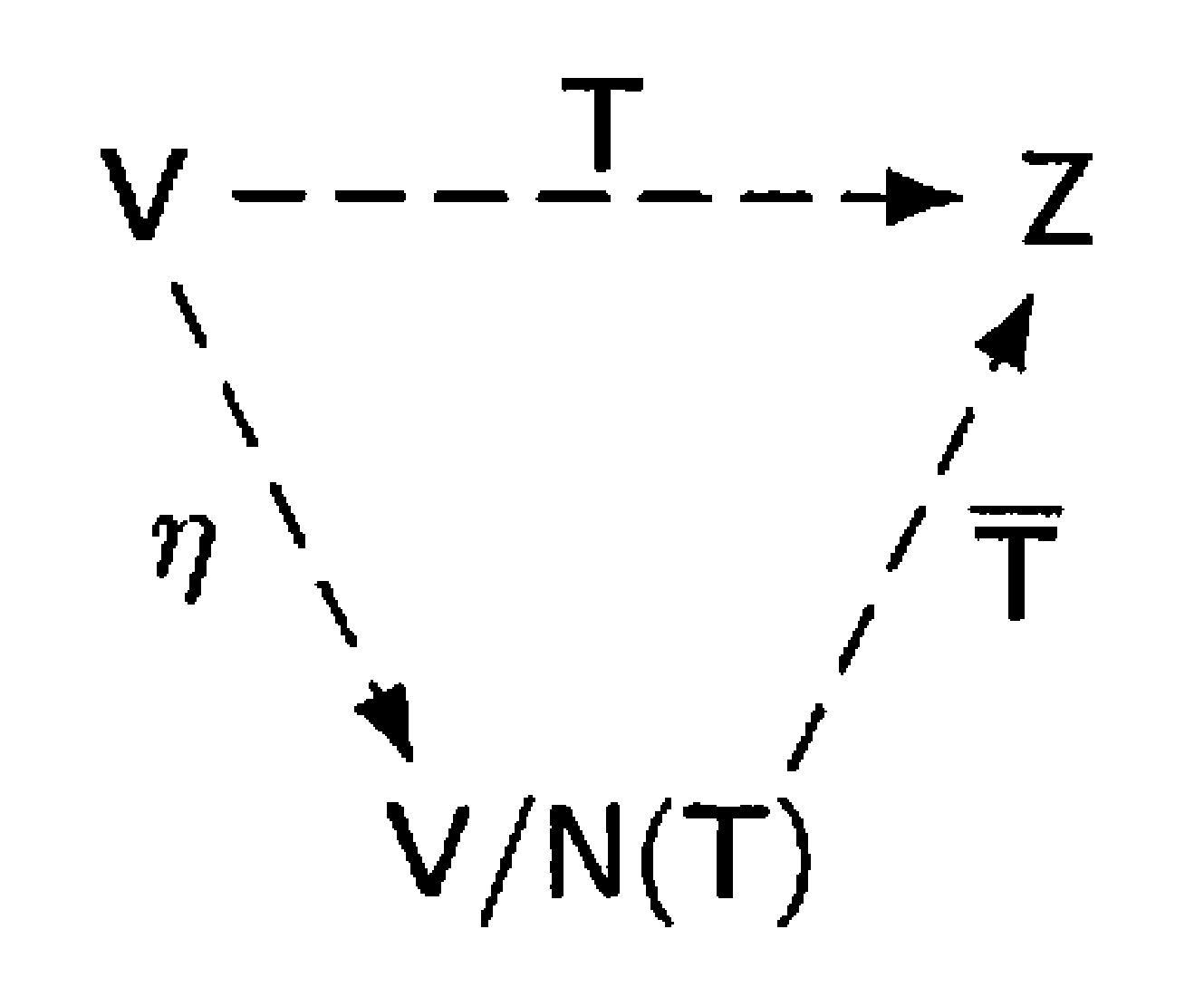
Figure 11.2.
Exercise 11.25
Let \(V\) be a nonzero vector space over a field \(F\), and suppose that \(S\) is a basis for \(V\). (By Corollary 7.10, every vector space has a basis.) Let \(\mathcal{C}(S, F)\) denote the vector space of all functions \(f \in \mathcal{F}(S, F)\) such that \(f(s)=0\) for all but a finite number of vectors in \(S\). (See Exercise 3.14) Let \(\Psi: \mathcal{C}(S, F) \rightarrow V\) be defined by \(\Psi(f)=0\) if \(f\) is the zero function, and
otherwise. Prove that \(\Psi\) is an isomorphism. Thus every nonzero vector space can be viewed as a space of functions.