§ 27. Compact Spaces of the Real Line¶
Theorem 27.1
Let \(X\) be a simply ordered set having the least upper bound property. In the order topology, each closed interval in \(X\) is compact.
Proof
Step 1.
Given \(a<b\), let \(\mathcal{A}\) be a covering of \([a, b]\) by sets open in \([a, b]\) in the subspace topology (which is the same as the order topology).
We wish to prove the existence of a finite subcollection of \(\mathcal{A}\) covering \([a, b]\).
First we prove the following: If \(x\) is a point of \([a, b]\) different from \(b\), then there is a point \(y>x\) of \([a, b]\) such that the interval \([x, y]\) can be covered by at most two elements of \(\mathcal{A}\).
If \(x\) has an immediate successor in \(X\), let \(y\) be this immediate successor. Then \([x, y]\) consists of the two points \(x\) and \(y\), so that it can be covered by at most two elements of \(\mathcal{A}\). If \(x\) has no immediate successor in \(X\), choose an element \(A\) of \(\mathcal{A}\) containing \(x\). Because \(x \neq b\) and \(A\) is open, \(A\) contains an interval of the form \([x, c)\), for some \(c\) in \([a, b]\). Choose a point \(y\) in \((x, c)\); then the interval \([x, y]\) is covered by the single element \(A\) of \(\mathcal{A}\).
Step 2.
Let \(C\) be the set of all points \(y>a\) of \([a, b]\) such that the interval \([a, y]\) can be covered by finitely many elements of \(\mathcal{A}\).
Applying Step 1 to the case \(x=a\), we see that there exists at least one such \(y\), so \(C\) is not empty.
Let \(c\) be the least upper bound of the set \(C\); then \(a<c \leq b\).
Step 3.
We show that \(c\) belongs to \(C\); that is, we show that the interval \([a, c]\) can be covered by finitely many elements of \(\mathcal{A}\).
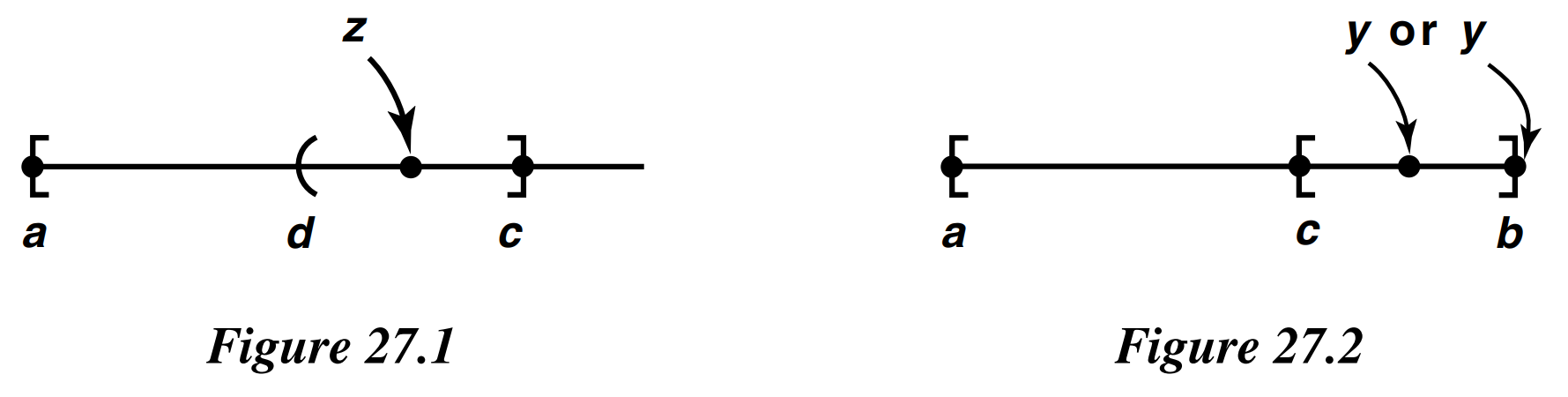
Choose an element \(A\) of \(\mathcal{A}\) containing \(c\); since \(A\) is open, it contains an interval of the form \((d, c]\) for some \(d\) in \([a, b]\).
If \(c\) is not in \(C\), there must be a point \(z\) of \(C\) lying in the interval \((d, c)\), because otherwise \(d\) would be a smaller upper bound on \(C\) than \(c\).
See Figure 27.1. Since \(z\) is in \(C\), the interval \([a, z]\) can be covered by finitely many, say \(n\), elements of \(\mathcal{A}\).
Now \([z, c]\) lies in the single element \(A\) of \(\mathcal{A}\), hence \([a, c]=[a, z] \cup[z, c]\) can be covered by \(n+1\) elements of \(\mathcal{A}\).
Thus \(c\) is in \(C\), contrary to assumption.
Step 4.
Finally, we show that \(c=b\), and our theorem is proved.
Suppose that \(c<b\).
Applying Step 1 to the case \(x=c\), we conclude that there exists a point \(y>c\) of \([a, b]\) such that the interval \([c, y]\) can be covered by finitely many elements of \(\mathcal{A}\).
See Figure 27.2.
We proved in Step 3 that \(c\) is in \(C\), so \([a, c]\) can be covered by finitely many elements of \(\mathcal{A}\).
Therefore, the interval
can also be covered by finitely many elements of \(\mathcal{A}\). This means that \(y\) is in \(C\), contradicting the fact that \(c\) is an upper bound on \(C\).
Corollary 27.2
Every closed interval in \(\mathbb{R}\) is compact.
Theorem 27.3
A subspace \(A\) of \(\mathbb{R}^{n}\) is compact if and only if it is closed and is bounded in the euclidean metric \(d\) or the square metric \(\rho\).
Proof
It will suffice to consider only the metric \(\rho\); the inequalities
imply that \(A\) is bounded under \(d\) if and only if is is bounded under \(\rho\).
Suppose that \(A\) is compact. Then, by Theorem 26.3, it is closed. Consider the collection of open sets
whose union is all of \(\mathbb{R}^{n}\). Some finite subcollection covers \(A\). It follows that \(A \subset\) \(B_{\rho}(\mathbf{0}, M)\) for some \(M\). Therefore, for any two points \(x\) and \(y\) of \(A\), we have \(\rho(x, y) \leq\) \(2 M\). Thus \(A\) is bounded under \(\rho\).
Conversely, suppose that \(A\) is closed and bounded under \(\rho\); suppose that \(\rho(x, y) \leq\) \(N\) for every pair \(x, y\) of points of \(A\). Choose a point \(x_{0}\) of \(A\), and let \(\rho\left(x_{0}, \mathbf{0}\right)=b\). The triangle inequality implies that \(\rho(x, \mathbf{0}) \leq N+b\) for every \(x\) in \(A\). If \(P=N+b\), then \(A\) is a subset of the cube \([-P, P]^{n}\), which is compact. Being closed, \(A\) is also compact.
Theorem 27.4 : Extreme Value Theorem
Let \(f: X \rightarrow Y\) be continuous, where \(Y\) is an ordered set in the order topology. If \(X\) is compact, then there exist points \(c\) and \(d\) in \(X\) such that \(f(c) \leq f(x) \leq f(d)\) for every \(x \in X\).
The extreme value theorem of calculus is the special case of this theorem that occurs when we take \(X\) to be a closed interval in \(\mathbb{R}\) and \(Y\) to be \(\mathbb{R}\).
Proof
Since \(f\) is continuous and \(X\) is compact, the set \(A=f(X)\) is compact. We show that \(A\) has a largest element \(M\) and a smallest element \(m\). Then since \(m\) and \(M\) belong to \(A\), we must have \(m=f(c)\) and \(M=f(d)\) for some points \(c\) and \(d\) of \(X\).
If \(A\) has no largest element, then the collection
forms an open covering of \(A\). Since \(A\) is compact, some finite subcollection
covers \(A\). If \(a_{i}\) is the largest of the elements \(a_{1}, \ldots a_{n}\), then \(a_{i}\) belongs to none of these sets, contrary to the fact that they cover \(A\).
A similar argument shows that \(A\) has a smallest element.
Definition 27.1 : Distance from x to A
Let \((X, d)\) be a metric space; let \(A\) be a nonempty subset of \(X\). For each \(x \in X\), we define the distance from \(x\) to \(A\) by the equation
Theorem 27.4.1
For fixed \(A\), the function \(d(x, A)\) is a continuous function of \(x\).
Proof
Given \(x, y \in X\), one has the inequalities
for each \(a \in A\). It follows that
so that
The same inequality holds with \(x\) and \(y\) interchanged; continuity of the function \(d(x, A)\) follows.
Lemma 27.5 : The Lebesgue Number Lemma
Let \(\mathcal{A}\) be an open covering of the metric space \((X, d)\). If \(X\) is compact, there is a \(\delta>0\) such that for each subset of \(X\) having diameter less than \(\delta\), there exists an element of \(\mathcal{A}\) containing it.
The number \(\delta\) is called a Lebesgue number for the covering \(\mathcal{A}\).
Proof
Let \(\mathcal{A}\) be an open covering of \(X\). If \(X\) itself is an element of \(\mathcal{A}\), then any positive number is a Lebesgue number for \(\mathcal{A}\). So assume \(X\) is not an element of \(\mathcal{A}\).
Choose a finite subcollection \(\left\{A_{1}, \ldots, A_{n}\right\}\) of \(\mathcal{A}\) that covers \(X\). For each \(i\), set \(C_{i}=X-A_{i}\), and define \(f: X \rightarrow \mathbb{R}\) by letting \(f(x)\) be the average of the numbers \(d\left(x, C_{i}\right)\). That is,
We show that \(f(x)>0\) for all \(x\). Given \(x \in X\), choose \(i\) so that \(x \in A_{i}\). Then choose \(\epsilon\) so the \(\epsilon\)-neighborhood of \(x\) lies in \(A_{i}\). Then \(d\left(x, C_{i}\right) \geq \epsilon\), so that \(f(x) \geq \epsilon / n\).
Since \(f\) is continuous, it has a minimum value \(\delta\); we show that \(\delta\) is our required Lebesgue number. Let \(B\) be a subset of \(X\) of diameter less than \(\delta\). Choose a point \(x_{0}\) of \(B\); then \(B\) lies in the \(\delta\)-neighborhood of \(x_{0}\). Now
where \(d\left(x_{0}, C_{m}\right)\) is the largest of the numbers \(d\left(x_{0}, C_{i}\right)\). Then the \(\delta\)-neighborhood of \(x_{0}\) is contained in the element \(A_{m}=X-C_{m}\) of the covering \(\mathcal{A}\).
Definition 27.2 : Uniformly Continuous
A function \(f\) from the metric space \(\left(X, d_{X}\right)\) to the metric space \(\left(Y, d_{Y}\right)\) is said to be uniformly continuous if given \(\epsilon>0\), there is a \(\delta>0\) such that for every pair of points \(x_{0}, x_{1}\) of \(X\),
Theorem 27.6 : Uniform Continuity Theorem
Let \(f: X \rightarrow Y\) be a continuous map of the compact metric space \(\left(X, d_{X}\right)\) to the metric space \(\left(Y, d_{Y}\right)\). Then \(f\) is uniformly continuous.
Proof
Given \(\epsilon>0\), take the open covering of \(Y\) by balls \(B(y, \epsilon / 2)\) of radius \(\epsilon / 2\). Let \(\mathcal{A}\) be the open covering of \(X\) by the inverse images of these balls under \(f\). Choose \(\delta\) to be a Lebesgue number for the covering \(\mathcal{A}\). Then if \(x_{1}\) and \(x_{2}\) are two points of \(X\) such that \(d_{X}\left(x_{1}, x_{2}\right)<\delta\), the two-point set \(\left\{x_{1}, x_{2}\right\}\) has diameter less than \(\delta\), so that its image \(\left\{f\left(x_{1}\right), f\left(x_{2}\right)\right\}\) lies in some ball \(B(y, \epsilon / 2)\). Then \(d_{Y}\left(f\left(x_{1}\right), f\left(x_{2}\right)\right)<\epsilon\), as desired.
Definition 27.3 : Isolated Point
If \(X\) is a space, a point \(x\) of \(X\) is said to be an isolated point of \(X\) if the one-point set \(\{x\}\) is open in \(X\).
Theorem 27.7
Let \(X\) be a nonempty compact Hausdorff space. If \(X\) has no isolated points, then \(X\) is uncountable.
Proof
Step 1.
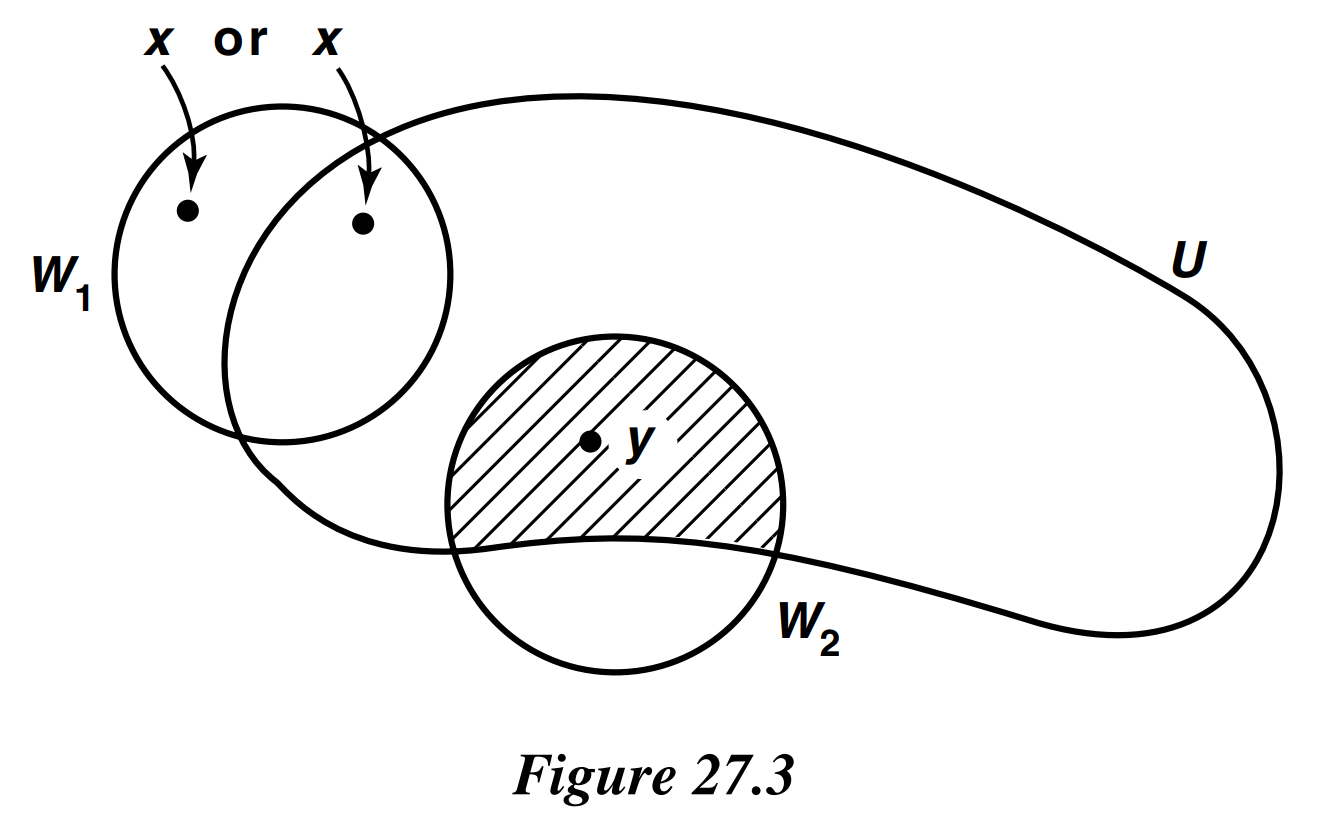
We show first that given any nonempty open set \(U\) of \(X\) and any point \(x\) of \(X\), there exists a nonempty open set \(V\) contained in \(U\) such that \(x \notin \bar{V}\).
Choose a point \(y\) of \(U\) different from \(x\); this is possible if \(x\) is in \(U\) because \(x\) is not an isolated point of \(X\) and it is possible if \(x\) is not in \(U\) simply because \(U\) is nonempty. Now choose disjoint open sets \(W_{1}\) and \(W_{2}\) about \(x\) and \(y\), respectively. Then the set \(V=W_{2} \cap U\) is the desired open set; it is contained in \(U\), it is nonempty because it contains \(y\), and its closure does not contain \(x\). See Figure 27.3.
Step 2.
We show that given \(f: \mathbb{Z}_{+} \rightarrow X\), the function \(f\) is not surjective.
It follows that \(X\) is uncountable.
Let \(x_{n}=f(n)\).
Apply Step 1 to the nonempty open set \(U=X\) to choose a nonempty open set \(V_{1} \subset X\) such that \(\bar{V}_{1}\) does not contain \(x_{1}\).
In general, given \(V_{n-1}\) open and nonempty, choose \(V_{n}\) to be a nonempty open set such that \(V_{n} \subset V_{n-1}\) and \(\bar{V}_{n}\) does not contain \(x_{n}\).
Consider the nested sequence
of nonempty closed sets of \(X\). Because \(X\) is compact, there is a point \(x \in \cap \bar{V}_{n}\), by Theorem 26.9. Now \(x\) cannot equal \(x_{n}\) for any \(n\), since \(x\) belongs to \(\bar{V}_{n}\) and \(x_{n}\) does not.
Corollary 27.8
Every closed interval in \(\mathbb{R}\) is uncountable.