§ 13. Basis for a Topology¶
Definition 13.1 : Basis / Topology Generated by Basis
If \(X\) is a set, a basis for a topology on \(X\) is a collection \(\mathcal{B}\) of subsets of \(X\) (called basis elements) such that
- For each \(x \in X\), there is at least one basis element \(B\) containing \(x\).
- If \(x\) belongs to the intersection of two basis elements \(B_{1}\) and \(B_{2}\), then there is a basis element \(B_{3}\) containing \(x\) such that \(B_{3} \subset B_{1} \cap B_{2}\).
(Basis \(\Rightarrow\) Topology)
If \(\mathcal{B}\) satisfies these two conditions, then we define the topology \(\mathcal{T}\) generated by \(\mathcal{B}\) as follows:
A subset \(U\) of \(X\) is said to be open in \(X\) (that is, to be an element of \(\mathcal{T}\) ) if for each \(x \in U\), there is a basis element \(B \in \mathcal{B}\) such that \(x \in B\) and \(B \subset U\).
Note that each basis element is itself an element of \(\mathcal{T}\).
Example
-
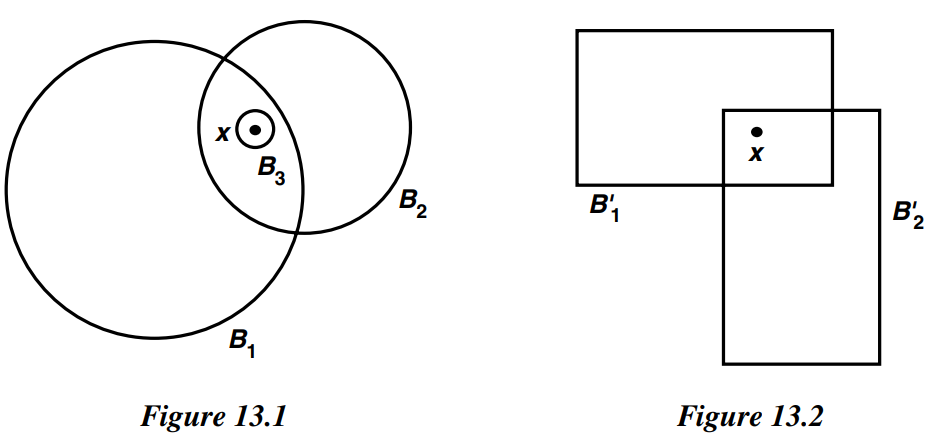
Let \(\mathcal{B}\) be the collection of all circular regions (interiors of circles) in the plane. Then \(\mathcal{B}\) satisfies both conditions for a basis. The second condition is illustrated in Figure 13.1. In the topology generated by \(\mathcal{B}\), a subset \(U\) of the plane is open if every \(x\) in \(U\) lies in some circular region contained in \(U\).
-
Let \(\mathcal{B}^{\prime}\) be the collection of all rectangular regions (interiors of rectangles) in the plane, where the rectangles have sides parallel to the coordinate axes. Then \(\mathcal{B}^{\prime}\) satisfies both conditions for a basis. The second condition is illustrated in Figure 13.2; in this case, the condition is trivial, because the intersection of any two basis elements is itself a basis element (or empty).
Theorem 13.0
The collection \(\mathcal{T}\) generated by the basis \(\mathcal{B}\) is, in fact, a topology on \(X\).
Proof
If \(U\) is the empty set, it satisfies the defining condition of openness vacuously. Likewise, \(X\) is in \(\mathcal{T}\), since for each \(x \in X\) there is some basis element \(B\) containing \(x\) and contained in \(X\).
Now let us take an indexed family \(\left\{U_{\alpha}\right\}_{\alpha \in J}\), of elements of \(\mathcal{T}\) and show that
belongs to \(\mathcal{T}\). Given \(x \in U\), there is an index \(\alpha\) such that \(x \in U_{\alpha}\). Since \(U_{\alpha}\) is open, there is a basis element \(B\) such that \(x \in B \subset U_{\alpha}\). Then \(x \in B\) and \(B \subset U\), so that \(U\) is open, by definition.
Now let us take two elements \(U_{1}\) and \(U_{2}\) of \(\mathcal{T}\) and show that \(U_{1} \cap U_{2}\) belongs to \(\mathcal{T}\). Given \(x \in U_{1} \cap U_{2}\), choose a basis element \(B_{1}\) containing \(x\) such that \(B_{1} \subset U_{1}\); choose also a basis element \(B_{2}\) containing \(x\) such that \(B_{2} \subset U_{2}\). The second condition for a basis enables us to choose a basis element \(B_{3}\) containing \(x\) such that \(B_{3} \subset B_{1} \cap B_{2}\). Then \(x \in B_{3}\) and \(B_{3} \subset U_{1} \cap U_{2}\), so \(U_{1} \cap U_{2}\) belongs to \(\mathcal{T}\), by definition.
Finally, we show by induction that any finite intersection \(U_{1} \cap \cdots \cap U_{n}\) of elements of \(\mathcal{T}\) is in \(\mathcal{T}\). This fact is trivial for \(n=1\); we suppose it true for \(n-1\) and prove it for \(n\). Now
By hypothesis, \(U_{1} \cap \cdots \cap U_{n-1}\) belongs to \(\mathcal{T}\); by the result just proved, the intersection of \(U_{1} \cap \cdots \cap U_{n-1}\) and \(U_{n}\) also belongs to \(\mathcal{T}\).
Thus we have checked that collection of open sets generated by a basis \(\mathcal{B}\) is, in fact, a topology.
Lemma 13.1
(Basis \(\Rightarrow\) Topology)
Let \(X\) be a set; let \(\mathcal{B}\) be a basis for a topology \(\mathcal{T}\) on \(X\). Then \(\mathcal{T}\) equals the collection of all unions of elements of \(\mathcal{B}\).
Proof
Given a collection of elements of \(\mathcal{B}\), they are also elements of \(\mathcal{T}\).
Because \(\mathcal{T}\) is a topology, their union is in \(\mathcal{T}\).
Conversely, given \(U \in \mathcal{T}\), choose for each \(x \in U\) an element \(B_{x}\) of \(\mathcal{B}\) such that \(x \in B_{x} \subset U\). Then \(U=\bigcup_{x \in U} B_{x}\), so \(U\) equals a union of elements of \(\mathcal{B}\).
Lemma 13.2
(Topology \(\Rightarrow\) Basis)
Let \(X\) be a topological space.
Suppose that \(C\) is a collection of open sets of \(X\) such that for each open set \(U\) of \(X\) and each \(x\) in \(U\), there is an element \(C\) of \(\mathcal{C}\) such that \(x \in C \subset U\).
Then \(\mathcal{C}\) is a basis for the topology of \(X\).
Proof
We must show that \(\mathcal{C}\) is a basis. The first condition for a basis is easy: Given \(x \in X\), since \(X\) is itself an open set, there is by hypothesis an element \(C\) of \(\mathcal{C}\) such that \(x \in C \subset X\). To check the second condition, let \(x\) belong to \(C_{1} \cap C_{2}\), where \(C_{1}\) and \(C_{2}\) are elements of \(C\). Since \(C_{1}\) and \(C_{2}\) are open, so is \(C_{1} \cap C_{2}\). Therefore, there exists by hypothesis an element \(C_{3}\) in \(C\) such that \(x \in C_{3} \subset C_{1} \cap C_{2}\).
Let \(\mathcal{T}\) be the collection of open sets of \(X\); we must show that the topology \(\mathcal{T}^{\prime}\) generated by \(\mathcal{C}\) equals the topology \(\mathcal{T}\). First, note that if \(U\) belongs to \(\mathcal{T}\) and if \(x \in U\), then there is by hypothesis an element \(C\) of \(\mathcal{C}\) such that \(x \in C \subset U\). It follows that \(U\) belongs to the topology \(\mathcal{T}^{\prime}\), by definition. Conversely, if \(W\) belongs to the topology \(\mathcal{T}^{\prime}\), then \(W\) equals a union of elements of \(\mathcal{C}\), by Lemma 13.1. Since each element of \(\mathcal{C}\) belongs to \(\mathcal{T}\) and \(\mathcal{T}\) is a topology, \(W\) also belongs to \(\mathcal{T}\).
Lemma 13.3
Let \(\mathcal{B}\) and \(\mathcal{B}^{\prime}\) be bases for the topologies \(\mathcal{T}\) and \(\mathcal{T}^{\prime}\), respectively, on \(X\). Then the following are equivalent:
- \(\mathcal{T}^{\prime}\) is finer than \(\mathcal{T}\). (\(\mathcal{T}^{\prime} \supset \mathcal{T}\))
- For each \(x \in X\) and each basis element \(B \in \mathcal{B}\) containing \(x\), there is a basis element \(B^{\prime} \in \mathcal{B}^{\prime}\) such that \(x \in B^{\prime} \subset B\).
Proof
(2) \(\Longrightarrow\) (1).
Given an element \(U\) of \(\mathcal{T}\), we wish to show that \(U \in \mathcal{T}^{\prime}\). Let \(x \in U\). Since \(\mathcal{B}\) generates \(\mathcal{T}\), there is an element \(B \in \mathcal{B}\) such that \(x \in B \subset U\). Condition (2) tells us there exists an element \(B^{\prime} \in \mathcal{B}^{\prime}\) such that \(x \in B^{\prime} \subset B\). Then \(x \in B^{\prime} \subset U\), so \(U \in \mathcal{T}\), by definition.
(1) \(\Longrightarrow\) (2).
We are given \(x \in X\) and \(B \in \mathcal{B}\), with \(x \in B\). Now \(B\) belongs to \(\mathcal{T}\) by definition and \(\mathcal{T} \subset \mathcal{T}^{\prime}\) by condition (1); therefore, \(B \in \mathcal{T}^{\prime}\). Since \(\mathcal{T}^{\prime}\) is generated by \(\mathcal{B}^{\prime}\), there is an element \(B^{\prime} \in \mathcal{B}^{\prime}\) such that \(x \in B^{\prime} \subset B\).
Example
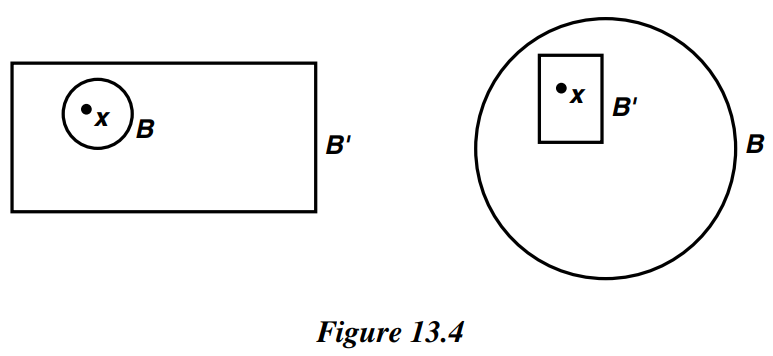
One can now see that the collection \(\mathcal{B}\) of all circular regions in the plane generates the same topology as the collection \(\mathcal{B}^{\prime}\) of all rectangular regions; Figure 13.4 illustrates the proof.
Definition 13.2 : Standard Topology
If \(\mathcal{B}\) is the collection of all open intervals in the real line,
the topology generated by \(\mathcal{B}\) is called the standard topology on the real line. Whenever we consider \(\mathbb{R}\), we shall suppose it is given this topology unless we specifically state otherwise.
Definition 13.3 : Lower Limit Topology
If \(\mathcal{B}^{\prime}\) is the collection of all half-open intervals of the form
where \(a<b\), the topology generated by \(\mathcal{B}^{\prime}\) is called the lower limit topology on \(\mathbb{R}\). When \(\mathbb{R}\) is given the lower limit topology, we denote it by \(\mathbb{R}_{\ell}\).
Definition 13.4 : K - Topology
Finally let \(K\) denote the set of all numbers of the form \(1 / n\), for \(n \in \mathbb{Z}_{+}\), and let \(\mathcal{B}^{\prime \prime}\) be the collection of all open intervals \((a, b)\), along with all sets of the form \((a, b)-K\).
The topology generated by \(\mathcal{B}^{\prime \prime}\) will be called the \({K}\)-topology on \(\mathbb{R}\).
When \(\mathbb{R}\) is given this topology, we denote it by \(\mathbb{R}_{K}\).
Lemma 13.4
The topologies of \(\mathbb{R}_{\ell}\) and \(\mathbb{R}_{K}\) are strictly finer than the standard topology on \(\mathbb{R}\), but are not comparable with one another.
Proof
Let \(\mathcal{T}, \mathcal{T}^{\prime}\), and \(\mathcal{T}^{\prime \prime}\) be the topologies of \(\mathbb{R}, \mathbb{R}_{\ell}\), and \(\mathbb{R}_{K}\), respectively. Given a basis element \((a, b)\) for \(\mathcal{T}\) and a point \(x\) of \((a, b)\), the basis element \([x, b)\) for \(\mathcal{T}^{\prime}\) contains \(x\) and lies in \((a, b)\). On the other hand, given the basis element \([x, d)\) for \(\mathcal{T}^{\prime}\), there is no open interval \((a, b)\) that contains \(x\) and lies in \([x, d)\). Thus \(\mathcal{T}^{\prime}\) is strictly finer than \(\mathcal{T}\).
A similar argument applies to \(\mathbb{R}_{K}\). Given a basis element \((a, b)\) for \(\mathcal{T}\) and a point \(x\) of \((a, b)\), this same interval is a basis element for \(\mathcal{T}^{\prime \prime}\) that contains \(x\). On the other hand, given the basis element \(B=(-1,1)-K\) for \(\mathcal{T}^{\prime \prime}\) and the point 0 of \(B\), there is no open interval that contains 0 and lies in \(B\).
Same examples can be applied to show that \(\mathbb{R}_{\ell}\) and \(\mathbb{R}_{K}\) are not comparable with one another.
Definition 13.5 : Subbasis / Topology Generated by Subbasis
A subbasis \(S\) for a topology on \(X\) is a collection of subsets of \(X\) whose union equals \(X\). The topology generated by the subbasis \(S\) is defined to be the collection \(\mathcal{T}\) of all unions of finite intersections of elements of \(S\).
Theorem 13.5
\(\mathcal{T}\), the topology generated by the subbasis \(S\) is a topology.
Proof
For this purpose it will suffice to show that the collection \(\mathcal{B}\) of all finite intersections of elements of \(\mathcal{S}\) is a basis, for then the collection \(\mathcal{T}\) of all unions of elements of \(\mathscr{B}\) is a topology, by Lemma 13.1.
Given \(x \in X\), it belongs to an element of \(\mathcal{S}\) and hence to an element of \(\mathscr{B}\); this is the first condition for a basis.
To check the second condition, let
be two elements of \(\mathscr{B}\). Their intersection
is also a finite intersection of elements of \(\mathcal{S}\), so it belongs to \(\mathcal{B}\).