§ 26. Compact Spaces¶
Definition 26.1 : Covering / Open Covering
A collection \(\mathcal{A}\) of subsets of a space \(X\) is said to cover \(X\), or to be a covering of \(X\), if the union of the elements of \(\mathcal{A}\) is equal to \(X\). It is called an open covering of \(X\) if its elements are open subsets of \(X\).
Definition 26.2 : Compact
A space \(X\) is said to be compact if every open covering \(\mathcal{A}\) of \(X\) contains a finite subcollection that also covers \(X\).
Example
The following subspace of \(\mathbb{R}\) is compact:
Given an open covering \(\mathcal{A}\) of \(X\), there is an element \(U\) of \(\mathcal{A}\) containing 0. The set \(U\) contains all but finitely many of the points \(1 / n\); choose, for each point of \(X\) not in \(U\), an element of \(\mathcal{A}\) containing it. The collection consisting of these elements of \(\mathcal{A}\), along with the element \(U\), is a finite subcollection of \(\mathcal{A}\) that covers \(X\).
Definition 26.3 : Cover in Subspace
If \(Y\) is a subspace of \(X\), a collection \(\mathcal{A}\) of subsets of \(X\) is said to cover \(Y\) if the union of its elements contains \(Y\).
Lemma 26.1
Let \(Y\) be a subspace of \(X\). Then \(Y\) is compact if and only if every covering of \(Y\) by sets open in \(X\) contains a finite subcollection covering \(Y\).
Proof
Suppose that \(Y\) is compact and \(\mathcal{A}=\left\{A_{\alpha}\right\}_{\alpha \in J}\) is a covering of \(Y\) by sets open in \(X\). Then the collection
is a covering of \(Y\) by sets open in \(Y\); hence a finite subcollection
covers \(Y\). Then \(\left\{A_{\alpha_{1}}, \ldots, A_{\alpha_{n}}\right\}\) is a subcollection of \(\mathcal{A}\) that covers \(Y\).
Conversely, suppose the given condition holds; we wish to prove \(Y\) compact. Let \(\mathcal{A}^{\prime}=\left\{A_{\alpha}^{\prime}\right\}\) be a covering of \(Y\) by sets open in \(Y\). For each \(\alpha\), choose a set \(A_{\alpha}\) open in \(X\) such that
The collection \(\mathcal{A}=\left\{A_{\alpha}\right\}\) is a covering of \(Y\) by sets open in \(X\). By hypothesis, some finite subcollection \(\left\{A_{\alpha_{1}}, \ldots, A_{\alpha_{n}}\right\}\) covers \(Y\). Then \(\left\{A_{\alpha_{1}}^{\prime}, \ldots, A_{\alpha_{n}}^{\prime}\right\}\) is a subcollection of \(\mathcal{A}^{\prime}\) that covers \(Y\).
Theorem 26.2
Every closed subspace of a compact space is compact.
Proof
Let \(Y\) be a closed subspace of the compact space \(X\). Given a covering \(\mathcal{A}\) of \(Y\) by sets open in \(X\), let us form an open covering \(\mathcal{B}\) of \(X\) by adjoining to \(\mathcal{A}\) the single open set \(X-Y\), that is,
Some finite subcollection of \(\mathcal{B}\) covers \(X\). If this subcollection contains the set \(X-Y\), discard \(X-Y\); otherwise, leave the subcollection alone. The resulting collection is a finite subcollection of \(\mathcal{A}\) that covers \(Y\).
Theorem 26.3
Every compact subspace of a Hausdorff space is closed.
Proof
Let \(Y\) be a compact subspace of the Hausdorff space \(X\). We shall prove that \(X-Y\) is open, so that \(Y\) is closed.
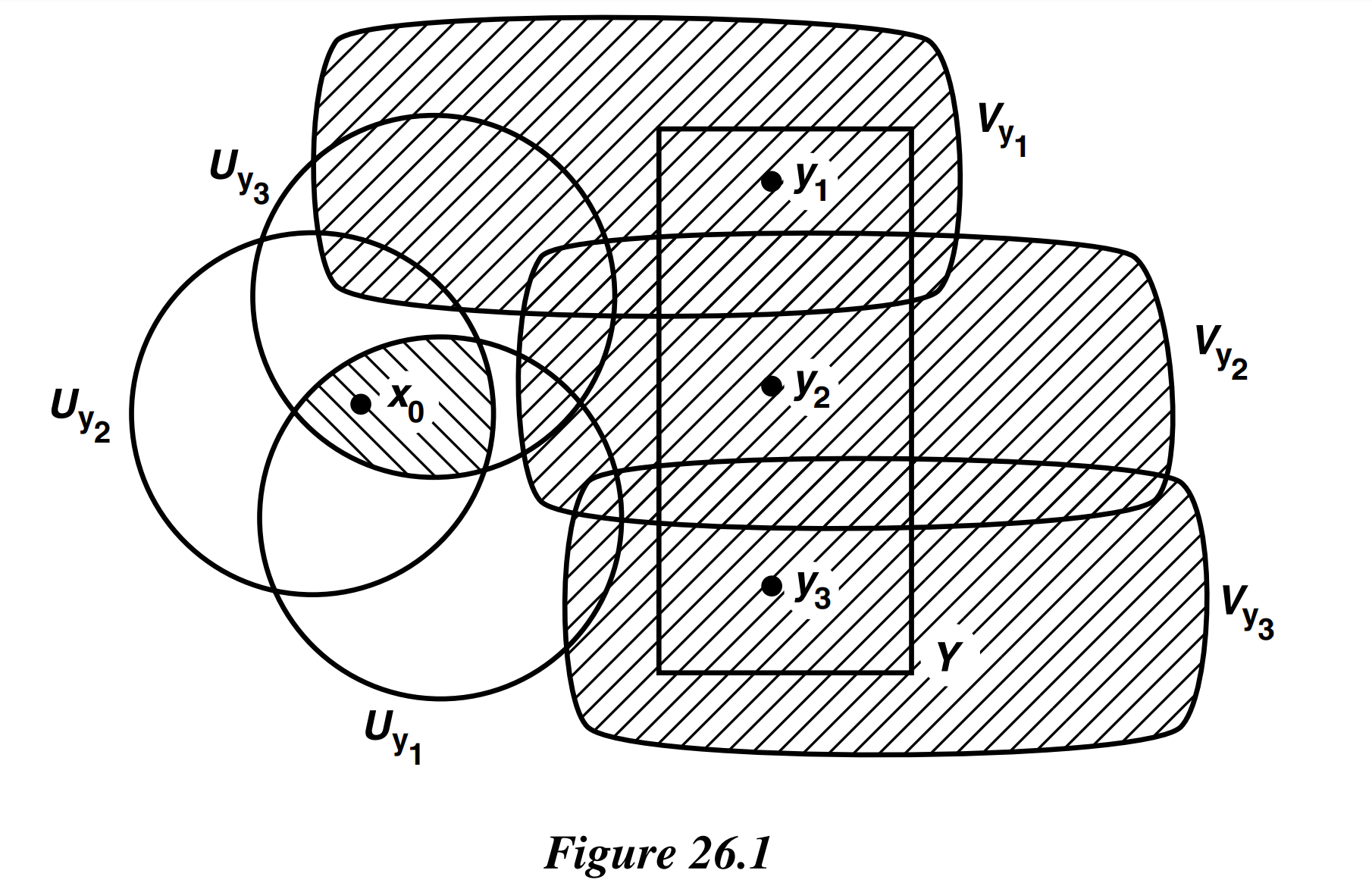
Let \(x_{0}\) be a point of \(X-Y\). We show there is a neighborhood of \(x_{0}\) that is disjoint from \(Y\). For each point \(y\) of \(Y\), let us choose disjoint neighborhoods \(U_{y}\) and \(V_{y}\) of the points \(x_{0}\) and \(y\), respectively (using the Hausdorff condition). The collection \(\left\{V_{y} \mid y \in\right.\) \(Y\}\) is a covering of \(Y\) by sets open in \(X\); therefore, finitely many of them \(V_{y_{1}}, \ldots, V_{y_{n}}\) cover \(Y\). The open set
contains \(Y\), and it is disjoint from the open set
formed by taking the intersection of the corresponding neighborhoods of \(x_{0}\). For if \(z\) is a point of \(V\), then \(z \in V_{y_{i}}\) for some \(i\), hence \(z \notin U_{y_{i}}\) and so \(z \notin U\). See Figure 26.1.
Then \(U\) is a neighborhood of \(x_{0}\) disjoint from \(Y\), as desired.
Lemma 26.4
If \(Y\) is a compact subspace of the Hausdorff space \(X\) and \(x_{0}\) is not in \(Y\), then there exist disjoint open sets \(U\) and \(V\) of \(X\) containing \(x_{0}\) and \(Y\), respectively.
Theorem 26.5
The image of a compact space under a continuous map is compact.
Proof
Let \(f: X \rightarrow Y\) be continuous; let \(X\) be compact. Let \(\mathcal{A}\) be a covering of the set \(f(X)\) by sets open in \(Y\). The collection
is a collection of sets covering \(X\); these sets are open in \(X\) because \(f\) is continuous. Hence finitely many of them, say
cover \(X\). Then the sets \(A_{1}, \ldots, A_{n}\) cover \(f(X)\).
Theorem 26.6
Let \(f: X \rightarrow Y\) be a bijective continuous function. If \(X\) is compact and \(Y\) is Hausdorff, then \(f\) is a homeomorphism.
Proof
We shall prove that images of closed sets of \(X\) under \(f\) are closed in \(Y\); this will prove continuity of the map \(f^{-1}\). If \(A\) is closed in \(X\), then \(A\) is compact, by Theorem 26.2. Therefore, by Theorem 26.5, \(f(A)\) is compact. Since \(Y\) is Hausdorff, \(f(A)\) is closed in \(Y\), by Theorem 26.3.
Theorem 26.7
The product of finitely many compact spaces is compact.
Proof
We shall prove that the product of two compact spaces is compact; the theorem follows by induction for any finite product.
Step 1.
Suppose that we are given spaces \(X\) and \(Y\), with \(Y\) compact.
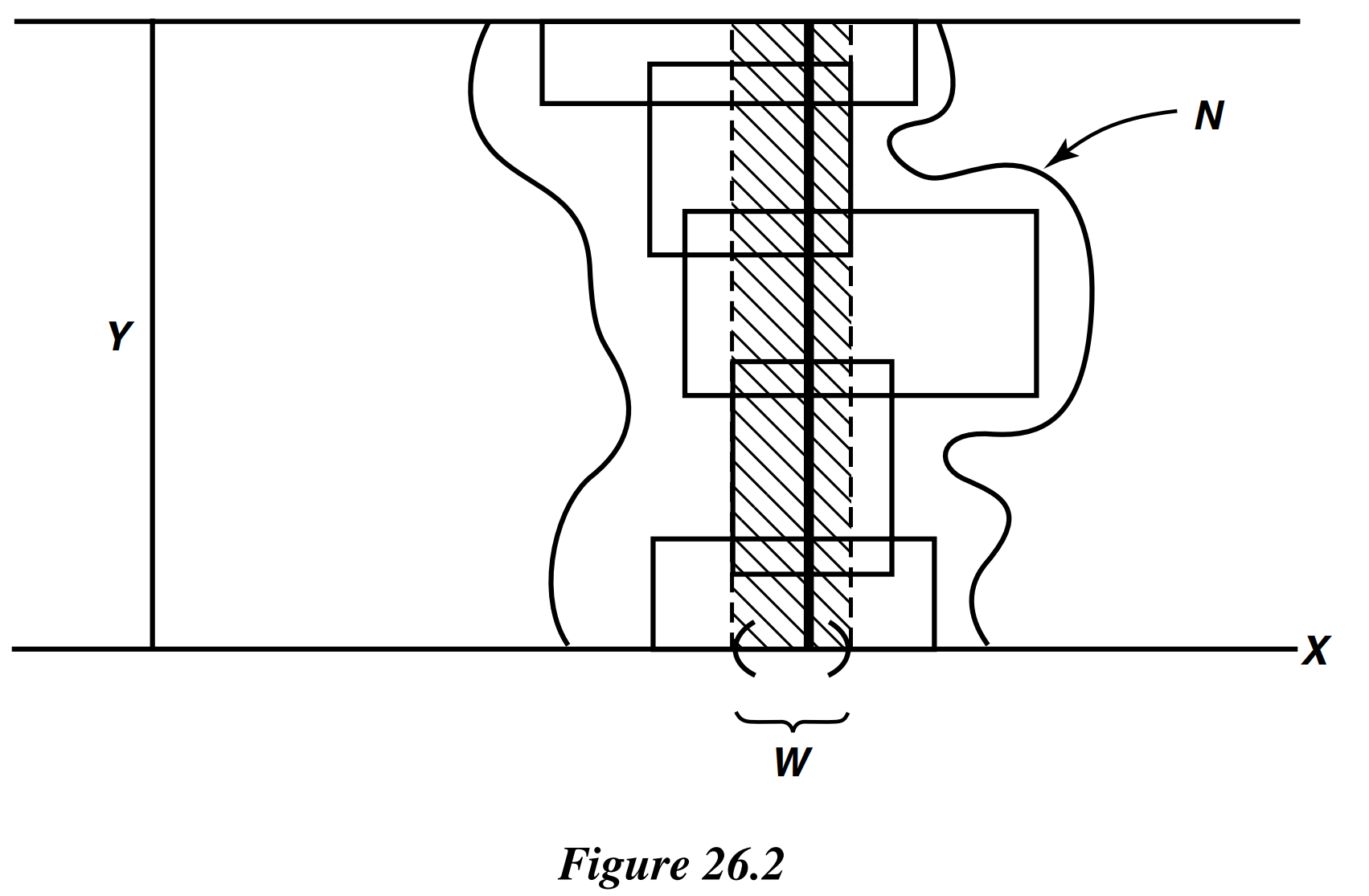
Suppose that \(x_{0}\) is a point of \(X\), and \(N\) is an open set of \(X \times Y\) containing the "slice" \(x_{0} \times Y\) of \(X \times Y\).
We prove the following:
There is a neighborhood \(W\) of \(x_{0}\) in \(X\) such that \(N\) contains the entire set \(W \times Y\).
The set \(W \times Y\) is often called a tube about \(x_{0} \times Y\).
First let us cover \(x_{0} \times Y\) by basis elements \(U \times V\) (for the topology of \(X \times Y\) ) lying in \(N\). The space \(x_{0} \times Y\) is compact, being homeomorphic to \(Y\). Therefore, we can cover \(x_{0} \times Y\) by finitely many such basis elements
(We assume that each of the basis elements \(U_{i} \times V_{i}\) actually intersects \(x_{0} \times Y\), since otherwise that basis element would be superfluous; we could discard it from the finite collection and still have a covering of \(x_{0} \times Y\).) Define
The set \(W\) is open, and it contains \(x_{0}\) because each set \(U_{i} \times V_{i}\) intersects \(x_{0} \times Y\).
We assert that the sets \(U_{i} \times V_{i}\), which were chosen to cover the slice \(x_{0} \times Y\), actually cover the tube \(W \times Y\). Let \(x \times y\) be a point of \(W \times Y\). Consider the point \(x_{0} \times y\) of the slice \(x_{0} \times Y\) having the same \(y\)-coordinate as this point. Now \(x_{0} \times y\) belongs to \(U_{i} \times V_{i}\) for some \(i\), so that \(y \in V_{i}\). But \(x \in U_{j}\) for every \(j\) (because \(x \in W\) ). Therefore, we have \(x \times y \in U_{i} \times V_{i}\), as desired.
Since all the sets \(U_{i} \times V_{i}\) lie in \(N\), and since they cover \(W \times Y\), the tube \(W \times Y\) lies in \(N\) also. See Figure 26.2.
Step 2.
Now we prove the theorem.
Let \(X\) and \(Y\) be compact spaces.
Let \(\mathcal{A}\) be an open covering of \(X \times Y\).
Given \(x_{0} \in X\), the slice \(x_{0} \times Y\) is compact and may therefore be covered by finitely many elements \(A_{1}, \ldots, A_{m}\) of \(\mathcal{A}\).
Their union \(N=A_{1} \cup \cdots \cup A_{m}\) is an open set containing \(x_{0} \times Y\); by Step 1, the open set \(N\) contains a tube \(W \times Y\) about \(x_{0} \times Y\), where \(W\) is open in \(X\).
Then \(W \times Y\) is covered by finitely many elements \(A_{1}, \ldots, A_{m}\) of \(\mathcal{A}\).
Thus, for each \(x\) in \(X\), we can choose a neighborhood \(W_{x}\) of \(x\) such that the tube \(W_{x} \times Y\) can be covered by finitely many elements of \(\mathcal{A}\). The collection of all the neighborhoods \(W_{x}\) is an open covering of \(X\); therefore by compactness of \(X\), there exists a finite subcollection
covering \(X\). The union of the tubes
is all of \(X \times Y\); since each may be covered by finitely many elements of \(\mathcal{A}\), so may \(X \times Y\) be covered.
Lemma 26.8 : The Tube Lemma
Consider the product space \(X \times Y\), where \(Y\) is compact. If \(N\) is an open set \(X \times Y\) containing the slice \(x_{0} \times Y\) of \(X \times Y\), then \(N\) contains some tube \(W \times Y\) about \(x_{0} \times Y\), where \(W\) is a neighborhood of \(x_{0}\) in \(X\).
Definition 26.4 : Finite Intersection Property
A collection \(C\) of subsets of \(X\) is said to have the finite intersection property if for every finite subcollection
of \(\mathcal{C}\), the intersection \(C_{1} \cap \cdots \cap C_{n}\) is nonempty.
Theorem 26.9
Let \(X\) be a topological space. Then \(X\) is compact if and only if for every collection \(C\) of closed sets in \(X\) having the finite intersection property, the intersection \(\bigcap_{C \in \mathcal{C}} C\) of all the elements of \(\mathcal{C}\) is nonempty.
Proof
Given a collection \(\mathcal{A}\) of subsets of \(X\), let
be the collection of their complements. Then the following statements hold:
-
\(\mathcal{A}\) is a collection of open sets if and only if \(\mathcal{C}\) is a collection of closed sets.
-
The collection \(\mathcal{A}\) covers \(X\) if and only if the intersection \(\bigcap_{C \in \mathcal{C}} C\) of all the elements of \(\mathcal{C}\) is empty.
-
The finite subcollection \(\left\{A_{1}, \ldots, A_{n}\right\}\) of \(\mathcal{A}\) covers \(X\) if and only if the intersection of the corresponding elements \(C_{i}=X-A_{i}\) of \(\mathcal{C}\) is empty.
The first statement is trivial, while the second and third follow from DeMorgan's law:
The proof of the theorem now proceeds in two easy steps: taking the contrapositive (of the theorem), and then the complement (of the sets)!
The statement that \(X\) is compact is equivalent to saying: "Given any collection \(\mathcal{A}\) of open subsets of \(X\), if \(\mathcal{A}\) covers \(X\), then some finite subcollection of \(\mathcal{A}\) covers \(X\)." This statement is equivalent to its contrapositive, which is the following: "Given any collection \(\mathcal{A}\) of open sets, if no finite subcollection of \(\mathcal{A}\) covers \(X\), then \(\mathcal{A}\) does not cover \(X\)." Letting \(C\) be, as earlier, the collection \(\{X-A \mid A \in \mathcal{A}\}\) and applying (1)-(3), we see that this statement is in turn equivalent to the following: "Given any collection \(\mathcal{C}\) of closed sets, if every finite intersection of elements of \(\mathcal{C}\) is nonempty, then the intersection of all the elements of \(\mathcal{C}\) is nonempty." This is just the condition of our theorem.
Lemma 26.10
A special case of Theorem 26.9 occurs when we have a nested sequence \(C_{1} \supset C_{2} \supset\) ... \(\supset C_{n} \supset C_{n+1} \supset \ldots\) of closed sets in a compact space \(X\). If each of the sets \(C_{n}\) is nonempty, then the collection \(C=\left\{C_{n}\right\}_{n \in \mathbb{Z}_{+}}\)automatically has the finite intersection property. Then the intersection
is nonempty.