§ 20. The Metric Topology¶
Definition 20.1 : Metric / Distance
A metric on a set \(X\) is a function
having the following properties:
-
\(d(x, y) \geq 0\) for all \(x, y \in X\); equality holds if and only if \(x=y\).
-
\(d(x, y)=d(y, x)\) for all \(x, y \in X\).
-
(Triangle inequality) \(d(x, y)+d(y, z) \geq d(x, z)\), for all \(x, y, z \in X\).
Given a metric \(d\) on \(X\), the number \(d(x, y)\) is often called the distance between \(x\) and \(y\) in the metric \(d\).
Definition 20.2 : \(\epsilon\)-ball centered at \(x\)
Given \(\epsilon>0\), consider the set
of all points \(y\) whose distance from \(x\) is less than \(\epsilon\). It is called the \(\epsilon\)-ball centered at \(x\). Sometimes we omit the metric \(d\) from the notation and write this ball simply as \(B(x, \epsilon)\), when no confusion will arise.
Definition 20.3 : Metric Topology
If \(d\) is a metric on the set \(X\), then the collection of all \(\epsilon\)-balls \(B_{d}(x, \epsilon)\), for \(x \in X\) and \(\epsilon>0\), is a basis for a topology on \(X\), called the metric topology induced by \(d\).
Theorem 20.0
If \(d\) is a metric on the set \(X\), then the collection of all \(\epsilon\)-balls \(B_{d}(x, \epsilon)\), for \(x \in X\) and \(\epsilon>0\), is indeed a basis for a topology on \(X\).
A set \(U\) is open in the metric topology induced by \(d\) if and only if for each \(y \in U\), there is a \(\delta>0\) such that \(B_{d}(y, \delta) \subset U\).
Proof
The first condition for a basis is trivial, since \(x \in B(x, \epsilon)\) for any \(\epsilon>0\).
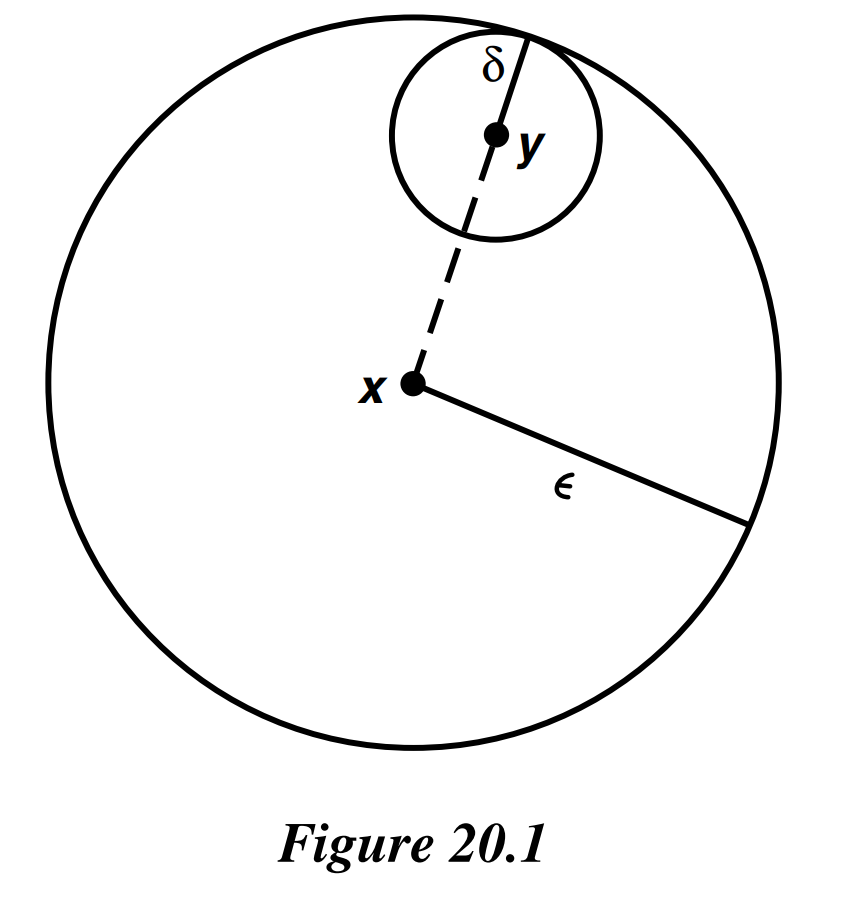
Before checking the second condition for a basis, we show that if \(y\) is a point of the basis element \(B(x, \epsilon)\), then there is a basis element \(B(y, \delta)\) centered at \(y\) that is contained in \(B(x, \epsilon)\). Define \(\delta\) to be the positive number \(\epsilon-d(x, y)\). Then \(B(y, \delta) \subset B(x, \epsilon)\), for if \(z \in B(y, \delta)\), then \(d(y, z)<\epsilon-d(x, y)\), from which we conclude that
Now to check the second condition for a basis, let \(B_{1}\) and \(B_{2}\) be two basis elements and let \(y \in B_{1} \cap B_{2}\). We have just shown that we can choose positive numbers \(\delta_{1}\) and \(\delta_{2}\) so that \(B\left(y, \delta_{1}\right) \subset B_{1}\) and \(B\left(y, \delta_{2}\right) \subset B_{2}\). Letting \(\delta\) be the smaller of \(\delta_{1}\) and \(\delta_{2}\), we conclude that \(B(y, \delta) \subset B_{1} \cap B_{2}\).
Definition 20.4 : Metrizable / Metric Space
If \(X\) is a topological space, \(X\) is said to be metrizable if there exists a metric \(d\) on the set \(X\) that induces the topology of \(X\). A metric space is a metrizable space \(X\) together with a specific metric \(d\) that gives the topology of \(X\).
Definition 20.5 : Bounded
Let \(X\) be a metric space with metric \(d\). A subset \(A\) of \(X\) is said to be bounded if there is some number \(M\) such that
for every pair \(a_{1}, a_{2}\) of points of \(A\).
Definition 20.6 : Diameter
If \(A\) is bounded and nonempty, the diameter of \(A\) is defined to be the number
Definition 20.7 : Standard Bounded Metric
Let \(X\) be a metric space with metric \(d\). Define \(\bar{d}: X \times X \rightarrow \mathbb{R}\) by the equation
The metric \(\bar{d}\) is called the standard bounded metric corresponding to \(d\).
Theorem 20.1
Let \(X\) be a metric space with metric \(d\).
Then the standard bounded metric \(\bar{d}\) is a metric that induces the same topology as \(d\).
Proof
Checking the first two conditions for a metric is trivial. Let us check the triangle inequality:
Now if either \(d(x, y) \geq 1\) or \(d(y, z) \geq 1\), then the right side of this inequality is at least 1 ; since the left side is (by definition) at most 1 , the inequality holds. It remains to consider the case in which \(d(x, y)<1\) and \(d(y, z)<1\). In this case, we have
Since \(\bar{d}(x, z) \leq d(x, z)\) by definition, the triangle inequality holds for \(\bar{d}\).
Now we note that in any metric space, the collection of \(\epsilon\)-balls with \(\epsilon<1\) forms a basis for the metric topology, for every basis element containing \(x\) contains such an \(\epsilon\)-ball centered at \(x\). It follows that \(d\) and \(\bar{d}\) induce the same topology on \(X\), because the collections of \(\epsilon\)-balls with \(\epsilon<1\) under these two metrics are the same collection.
Definition 20.8 : Norm / Euclidean Metric / Square Metric
Given \(\mathbf{x}=\left(x_{1}, \ldots, x_{n}\right)\) in \(\mathbb{R}^{n}\), we define the norm of \(\mathbf{x}\) by the equation
and we define the euclidean metric \(d\) on \(\mathbb{R}^{n}\) by the equation
We define the square metric \(\rho\) by the equation
Lemma 20.2
Let \(d\) and \(d^{\prime}\) be two metrics on the set \(X\); let \(\mathcal{T}\) and \(\mathcal{T}^{\prime}\) be the topologies they induce, respectively. Then \(\mathcal{T}^{\prime}\) is finer than \(\mathcal{T}\) if and only if for each \(x\) in \(X\) and each \(\epsilon>0\), there exists a \(\delta>0\) such that
Proof
Suppose that \(\mathcal{T}^{\prime}\) is finer than \(\mathcal{T}\). Given the basis element \(B_{d}(x, \epsilon)\) for \(\mathcal{T}\), there is by Lemma 13.3 a basis element \(B^{\prime}\) for the topology \(\mathcal{T}^{\prime}\) such that \(x \in B^{\prime} \subset B_{d}(x, \epsilon)\). Within \(B^{\prime}\) we can find a ball \(B_{d^{\prime}}(x, \delta)\) centered at \(x\).
Conversely, suppose the \(\delta-\epsilon\) condition holds. Given a basis element \(B\) for \(\mathcal{T}\) containing \(x\), we can find within \(B\) a ball \(B_{d}(x, \epsilon)\) centered at \(x\). By the given condition, there is a \(\delta\) such that \(B_{d^{\prime}}(x, \delta) \subset B_{d}(x, \epsilon)\). Then Lemma 13.3 applies to show \(\mathcal{T}^{\prime}\) is finer than \(\mathcal{T}\).
Theorem 20.3
The topologies on \(\mathbb{R}^{n}\) induced by the euclidean metric \(d\) and the square metric \(\rho\) are the same as the product topology on \(\mathbb{R}^{n}\).
Proof
Let \(\mathbf{x}=\left(x_{1}, \ldots, x_{n}\right)\) and \(\mathbf{y}=\left(y_{1}, \ldots, y_{n}\right)\) be two points of \(\mathbb{R}^{n}\). It is simple algebra to check that
The first inequality shows that
for all \(\mathbf{x}\) and \(\epsilon\), since if \(d(\mathbf{x}, \mathbf{y})<\epsilon\), then \(\rho(\mathbf{x}, \mathbf{y})<\epsilon\) also. Similarly, the second inequality shows that
for all \(\mathbf{x}\) and \(\epsilon\). It follows from the preceding lemma that the two metric topologies are the same.
Now we show that the product topology is the same as that given by the metric \(\rho\). First, let
be a basis element for the product topology, and let \(\mathbf{x}=\left(x_{1}, \ldots, x_{n}\right)\) be an element of \(B\). For each \(i\), there is an \(\epsilon_{i}\) such that
choose \(\epsilon=\min \left\{\epsilon_{1}, \ldots, \epsilon_{n}\right\}\). Then \(B_{\rho}(\mathbf{x}, \epsilon) \subset B\), as you can readily check. As a result, the \(\rho\)-topology is finer than the product topology.
Conversely, let \(B_{\rho}(\mathbf{x}, \epsilon)\) be a basis element for the \(\rho\)-topology. Given the element \(\mathbf{y} \in B_{\rho}(\mathbf{x}, \epsilon)\), we need to find a basis element \(B\) for the product topology such that
But this is trivial, for
is itself a basis element for the product topology.
Definition 20.9 : Uniform Metric / Uniform Topology
Given an index set \(J\), and given points \(\mathbf{x}=\left(x_{\alpha}\right)_{\alpha \in J}\) and \(\mathbf{y}=\left(y_{\alpha}\right)_{\alpha \in J}\) of \(\mathbb{R}^{J}\), let us define a metric \(\bar{\rho}\) on \(\mathbb{R}^{J}\) by the equation
where \(\bar{d}\) is the standard bounded metric on \(\mathbb{R}\). It is easy to check that \(\bar{\rho}\) is indeed a metric; it is called the uniform metric on \(\mathbb{R}^{J}\), and the topology it induces is called the uniform topology.
Theorem 20.4
The uniform topology on \(\mathbb{R}^{J}\) is finer than the product topology and coarser than the box topology; these three topologies are all different if \(J\) is infinite.
Proof
Suppose that we are given a point \(\mathbf{x}=\left(x_{\alpha}\right)_{\alpha \in J}\) and a product topology basis element \(\prod U_{\alpha}\) about \(\mathbf{x}\). Let \(\alpha_{1}, \ldots, \alpha_{n}\) be the indices for which \(U_{\alpha} \neq \mathbb{R}\). Then for each \(i\), choose \(\epsilon_{i}>0\) so that the \(\epsilon_{i}\)-ball centered at \(x_{\alpha_{i}}\) in the \(\bar{d}\) metric is contained in \(U_{\alpha_{i}}\); this we can do because \(U_{\alpha_{i}}\) is open in \(\mathbb{R}\). Let \(\epsilon=\min \left\{\epsilon_{1}, \ldots, \epsilon_{n}\right\}\); then the \(\epsilon\)-ball centered at \(\mathbf{x}\) in the \(\bar{\rho}\) metric is contained in \(\prod U_{\alpha}\). For if \(\mathbf{z}\) is a point of \(\mathbb{R}^{J}\) such that \(\bar{\rho}(\mathbf{x}, \mathbf{z})<\epsilon\), then \(\bar{d}\left(x_{\alpha}, z_{\alpha}\right)<\epsilon\) for all \(\alpha\), so that \(\mathbf{z} \in \prod U_{\alpha}\). It follows that the uniform topology is finer than the product topology.
On the other hand, let \(B\) be the \(\epsilon\)-ball centered at \(\mathbf{x}\) in the \(\bar{\rho}\) metric. Then the box neighborhood
of \(\mathbf{x}\) is contained in \(B\). For if \(\mathbf{y} \in U\), then \(\bar{d}\left(x_{\alpha}, y_{\alpha}\right)<\frac{1}{2} \epsilon\) for all \(\alpha\), so that \(\bar{\rho}(\mathbf{x}, \mathbf{y}) \leq\) \(\frac{1}{2} \epsilon\).
Theorem 20.5
Let \(\bar{d}(a, b)=\min \{|a-b|, 1\}\) be the standard bounded metric on \(\mathbb{R}\). If \(\mathbf{x}\) and \(\mathbf{y}\) are two points of \(\mathbb{R}^{\omega}\), define
Then \(D\) is a metric that induces the product topology on \(\mathbb{R}^{\omega}\).
Proof
The properties of a metric are satisfied trivially except for the triangle inequality, which is proved by noting that for all \(i\),
so that
The fact that \(D\) gives the product topology requires a little more work. First, let \(U\) be open in the metric topology and let \(\mathbf{x} \in U\); we find an open set \(V\) in the product topology such that \(\mathbf{x} \in V \subset U\). Choose an \(\epsilon\)-ball \(B_{D}(\mathbf{x}, \epsilon)\) lying in \(U\). Then choose \(N\) large enough that \(1 / N<\epsilon\). Finally, let \(V\) be the basis element for the product topology
We assert that \(V \subset B_{D}(\mathbf{x}, \epsilon)\) : Given any \(\mathbf{y}\) in \(\mathbb{R}^{\omega}\),
Therefore,
If \(\mathbf{y}\) is in \(V\), this expression is less than \(\epsilon\), so that \(V \subset B_{D}(\mathbf{x}, \epsilon)\), as desired.
Conversely, consider a basis element
for the product topology, where \(U_{i}\) is open in \(\mathbb{R}\) for \(i=\alpha_{1}, \ldots, \alpha_{n}\) and \(U_{i}=\mathbb{R}\) for all other indices \(i\). Given \(\mathbf{x} \in U\), we find an open set \(V\) of the metric topology such that \(\mathbf{x} \in V \subset U\). Choose an interval \(\left(x_{i}-\epsilon_{i}, x_{i}+\epsilon_{i}\right)\) in \(\mathbb{R}\) centered about \(x_{i}\) and lying in \(U_{i}\) for \(i=\alpha_{1}, \ldots, \alpha_{n}\); choose each \(\epsilon_{i} \leq 1\). Then define
We assert that
Let \(\mathbf{y}\) be a point of \(B_{D}(\mathbf{x}, \epsilon)\). Then for all \(i\),
Now if \(i=\alpha_{1}, \ldots, \alpha_{n}\), then \(\epsilon \leq \epsilon_{i} / i\), so that \(\bar{d}\left(x_{i}, y_{i}\right)<\epsilon_{i} \leq 1\); it follows that \(\left|x_{i}-y_{i}\right|<\epsilon_{i}\). Therefore, \(\mathbf{y} \in \prod U_{i}\), as desired.