§ 15. The Product Topology on \(X\) \(\times\) \(Y\)¶
Definition 15.1 : Product Topology
Let \(X\) and \(Y\) be topological spaces.
The product topology on \(X \times Y\) is the topology having as basis the collection \(\mathcal{B}\) of all sets of the form \(U \times V\), where \(U\) is an open subset of \(X\) and \(V\) is an open subset of \(Y\).
Theorem 15.0
Let \(X\) and \(Y\) be topological spaces.
The collection \(\mathcal{B}\) of all sets of the form \(U \times V\), where \(U\) is an open subset of \(X\) and \(V\) is an open subset of \(Y\), is indeed a basis.
The collection \(\mathcal{B}\) is not a topology on \(X \times Y\).
Proof
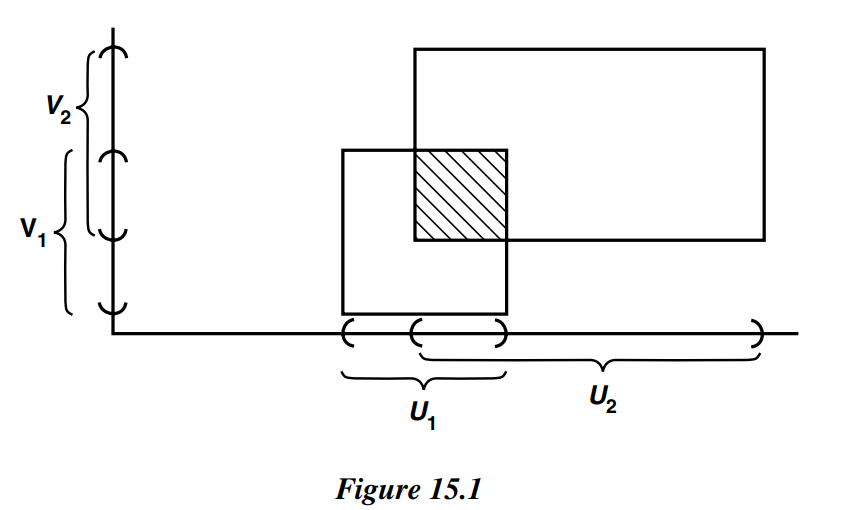
Let us check that \(\mathcal{B}\) is a basis. The first condition is trivial, since \(X \times Y\) is itself a basis element. The second condition is almost as easy, since the intersection of any two basis elements \(U_{1} \times V_{1}\) and \(U_{2} \times V_{2}\) is another basis element. For
and the latter set is a basis element because \(U_{1} \cap U_{2}\) and \(V_{1} \cap V_{2}\) are open in \(X\) and \(Y\), respectively. See Figure 15.1.
Note that the collection \(\mathcal{B}\) is not a topology on \(X \times Y\). The union of the two rectangles pictured in Figure 15.1, for instance, is not a product of two sets, so it cannot belong to \(\mathcal{B}\); however, it is open in \(X \times Y\).
Theorem 15.1
If \(\mathcal{B}\) is a basis for the topology of \(X\) and \(\mathcal{C}\) is a basis for the topology of \(Y\), then the collection
is a basis for the topology of \(X \times Y\).
Proof
We apply Lemma 13.2. Given an open set \(W\) of \(X \times Y\) and a point \(x \times y\) of \(W\), by definition of the product topology there is a basis element \(U \times V\) such that \(x \times y \in U \times V \subset W\). Because \(\mathcal{B}\) and \(\mathcal{C}\) are bases for \(X\) and \(Y\), respectively, we can choose an element \(B\) of \(\mathcal{B}\) such that \(x \in B \subset U\), and an element \(C\) of \(\mathcal{C}\) such that \(y \in C \subset V\). Then \(x \times y \in B \times C \subset W\). Thus the collection \(D\) meets the criterion of Lemma 13.2, so \(\mathcal{D}\) is a basis for \(X \times Y\).
Definition 15.2 : Standard Topology on \(\mathbb{R}^2\)
We have a standard topology on \(\mathbb{R}\) : the order topology. The product of this topology with itself is called the standard topology on \(\mathbb{R} \times \mathbb{R}=\mathbb{R}^{2}\).
It has as basis the collection of all products of open sets of \(\mathbb{R}\), but Theorem 15.1 tells us that the much smaller collection of all products \((a, b) \times(c, d)\) of open intervals in \(\mathbb{R}\) will also serve as a basis for the topology of \(\mathbb{R}^{2}\). Each such set can be pictured as the interior of a rectangle in \(\mathbb{R}^{2}\).
Definition 15.3 : Projection
Let \(\pi_{1}: X \times Y \rightarrow X\) be defined by the equation
let \(\pi_{2}: X \times Y \rightarrow Y\) be defined by the equation
The maps \(\pi_{1}\) and \(\pi_{2}\) are called the projections of \(X \times Y\) onto its first and second factors, respectively.
Theorem 15.2
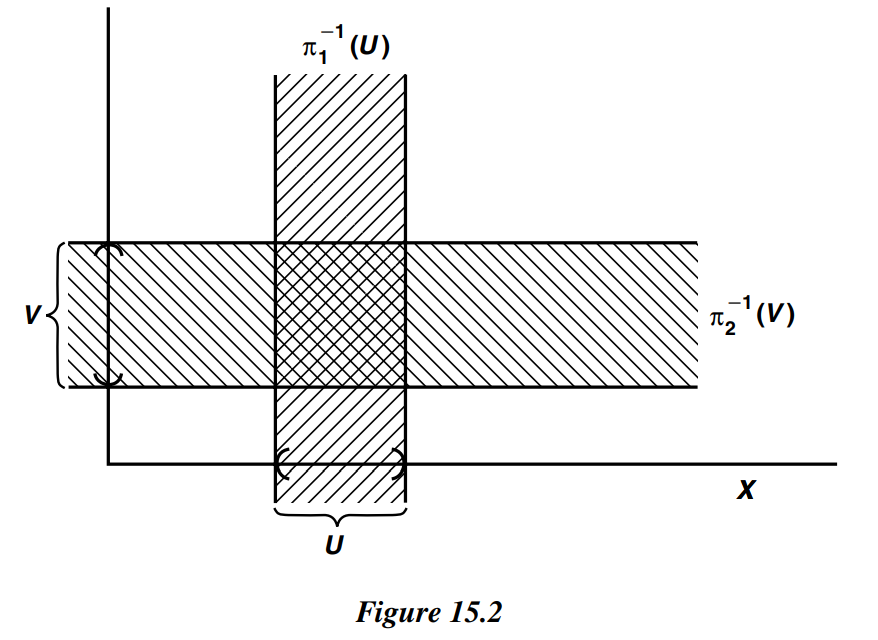
The collection
is a subbasis for the product topology on \(X \times Y\).
Proof
Let \(\mathcal{T}\) denote the product topology on \(X \times Y\); let \(\mathcal{T}^{\prime}\) be the topology generated by \(\mathcal{S}\).
Because every element of \(\mathcal{S}\) belongs to \(\mathcal{T}\), so do arbitrary unions of finite intersections of elements of \(\mathcal{S}\).
Thus \(\mathcal{T}^{\prime} \subset \mathcal{T}\).
On the other hand, every basis element \(U \times V\) for the topology \(\mathcal{T}\) is a finite intersection of elements of \(\mathcal{S}\), since
Therefore, \(U \times V\) belongs to \(\mathcal{T}^{\prime}\), so that \(\mathcal{T} \subset \mathcal{T}^{\prime}\) as well.