§ 23. Connected Spaces¶
Definition 23.1 : Connected Space / Separation
Let \(X\) be a topological space. A separation of \(X\) is a pair \(U, V\) of disjoint nonempty open subsets of \(X\) whose union is \(X\). The space \(X\) is said to be connected if there does not exist a separation of \(X\).
Theorem 23.0
A space \(X\) is connected if and only if the only subsets of \(X\) that are both open and closed in \(X\) are the empty set and \(X\) itself.
Proof
For if \(A\) is a nonempty proper subset of \(X\) that is both open and closed in \(X\), then the sets \(U=A\) and \(V=X-A\) constitute a separation of \(X\), for they are open, disjoint, and nonempty, and their union is \(X\).
Conversely, if \(U\) and \(V\) form a separation of \(X\), then \(U\) is nonempty and different from \(X\), and it is both open and closed in \(X\).
Lemma 23.1
If \(Y\) is a subspace of \(X\), a separation of \(Y\) is a pair of disjoint nonempty sets \(A\) and \(B\) whose union is \(Y\), neither of which contains a limit point of the other. The space \(Y\) is connected if there exists no separation of \(Y\).
Proof
Suppose first that \(A\) and \(B\) form a separation of \(Y\). Then \(A\) is both open and closed in \(Y\). The closure of \(A\) in \(Y\) is the set \(\bar{A} \cap Y\) (where \(\bar{A}\) as usual denotes the closure of \(A\) in \(X\) ). Since \(A\) is closed in \(Y, A=\bar{A} \cap Y\); or to say the same thing, \(\bar{A} \cap B=\varnothing\). Since \(\bar{A}\) is the union of \(A\) and its limit points, \(B\) contains no limit points of \(A\). A similar argument shows that \(A\) contains no limit points of \(B\).
Conversely, suppose that \(A\) and \(B\) are disjoint nonempty sets whose union is \(Y\), neither of which contains a limit point of the other. Then \(\bar{A} \cap B=\varnothing\) and \(A \cap \bar{B}=\varnothing\); therefore, we conclude that \(\bar{A} \cap Y=A\) and \(\bar{B} \cap Y=B\). Thus both \(A\) and \(B\) are closed in \(Y\), and since \(A=Y-B\) and \(B=Y-A\), they are open in \(Y\) as well.
Lemma 23.2
If the sets \(C\) and \(D\) form a separation of \(X\), and if \(Y\) is a connected subspace of \(X\), then \(Y\) lies entirely within either \(C\) or \(D\).
Proof
Since \(C\) and \(D\) are both open in \(X\), the sets \(C \cap Y\) and \(D \cap Y\) are open in \(Y\). These two sets are disjoint and their union is \(Y\); if they were both nonempty, they would constitute a separation of \(Y\). Therefore, one of them is empty. Hence \(Y\) must lie entirely in \(C\) or in \(D\).
Theorem 23.3
The union of a collection of connected subspaces of \(X\) that have a point in common is connected.
Proof
Let \(\left\{A_{\alpha}\right\}\) be a collection of connected subspaces of a space \(X\); let \(p\) be a point of \(\bigcap A_{\alpha}\). We prove that the space \(Y=\bigcup A_{\alpha}\) is connected. Suppose that \(Y=C \cup D\) is a separation of \(Y\). The point \(p\) is in one of the sets \(C\) or \(D\); suppose \(p \in C\). Since \(A_{\alpha}\) is connected, it must lie entirely in either \(C\) or \(D\) (by Lemma 23.2), and it cannot lie in \(D\) because it contains the point \(p\) of \(C\). Hence \(A_{\alpha} \subset C\) for every \(\alpha\), so that \(\bigcup A_{\alpha} \subset C\), contradicting the fact that \(D\) is nonempty.
Theorem 23.4
Let \(A\) be a connected subspace of \(X\). If \(A \subset B \subset \bar{A}\), then \(B\) is also connected.
Said differently: If \(B\) is formed by adjoining to the connected subspace \(A\) some or all of its limit points, then \(B\) is connected.
Proof
Let \(A\) be connected and let \(A \subset B \subset \bar{A}\). Suppose that \(B=C \cup D\) is a separation of \(B\). By Lemma 23.2, the set \(A\) must lie entirely in \(C\) or in \(D\); suppose that \(A \subset C\). Then \(\bar{A} \subset \bar{C}\); since \(\bar{C}\) and \(D\) are disjoint, \(B\) cannot intersect \(D\). This contradicts the fact that \(D\) is a nonempty subset of \(B\).
Theorem 23.5
The image of a connected space under a continuous map is connected.
Proof
Let \(f: X \rightarrow Y\) be a continuous map; let \(X\) be connected. We wish to prove the image space \(Z=f(X)\) is connected. Since the map obtained from \(f\) by restricting its range to the space \(Z\) is also continuous, it suffices to consider the case of a continuous surjective map
Suppose that \(Z=A \cup B\) is a separation of \(Z\) into two disjoint nonempty sets open in \(Z\). Then \(g^{-1}(A)\) and \(g^{-1}(B)\) are disjoint sets whose union is \(X\); they are open in \(X\) because \(g\) is continuous, and nonempty because \(g\) is surjective. Therefore, they form a separation of \(X\), contradicting the assumption that \(X\) is connected.
Theorem 23.6
A finite cartesian product of connected spaces is connected.
Proof
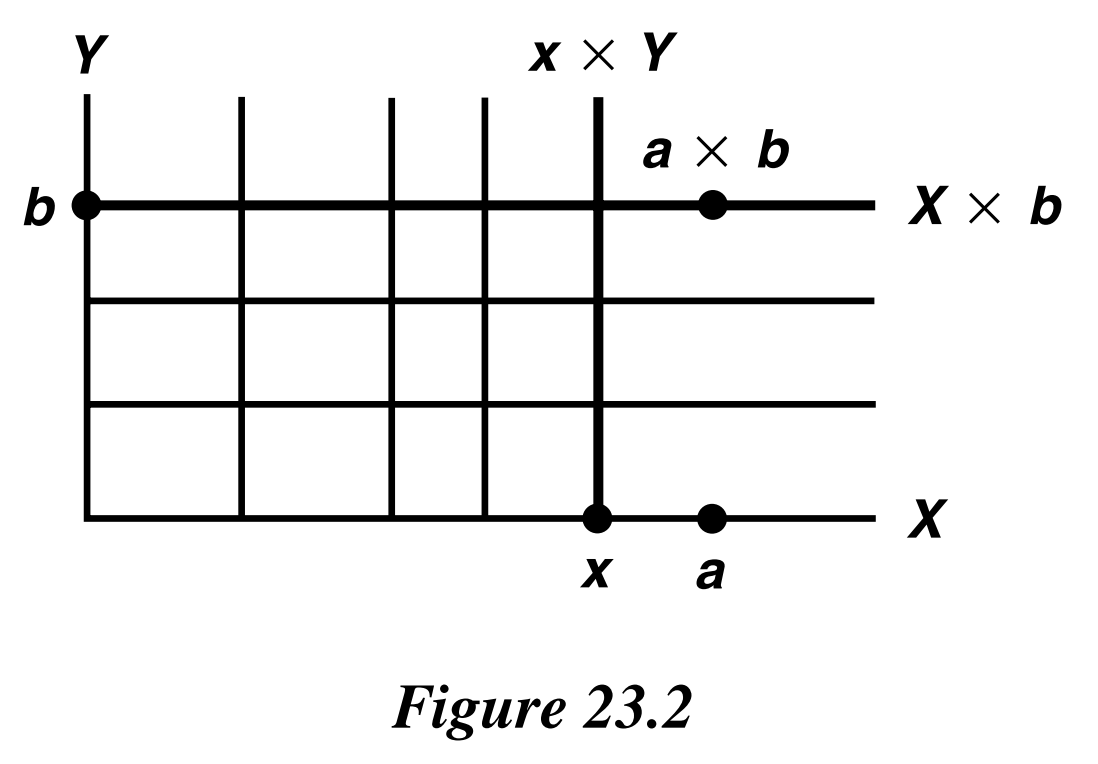
We prove the theorem first for the product of two connected spaces \(X\) and \(Y\). This proof is easy to visualize. Choose a "base point" \(a \times b\) in the product \(X \times Y\). Note that the "horizontal slice" \(X \times b\) is connected, being homeomorphic with \(X\), and each "vertical slice" \(x \times Y\) is connected, being homeomorphic with \(Y\). As a result, each "T-shaped" space
is connected, being the union of two connected spaces that have the point \(x \times b\) in common. See Figure 23.2. Now form the union \(\bigcup_{x \in X} T_{x}\) of all these T-shaped spaces. This union is connected because it is the union of a collection of connected spaces that have the point \(a \times b\) in common. Since this union equals \(X \times Y\), the space \(X \times Y\) is connected.
The proof for any finite product of connected spaces follows by induction, using the fact (easily proved) that \(X_{1} \times \cdots \times X_{n}\) is homeomorphic with \(\left(X_{1} \times \cdots \times X_{n-1}\right) \times\) \(X_{n}\).