§ 24. Connected Subspaces of the Real Line¶
Definition 24.1 : Linear Continuum
A simply ordered set \(L\) having more than one element is called a linear continuum if the following hold:
-
\(L\) has the least upper bound property.
-
If \(x<y\), there exists \(z\) such that \(x<z<y\).
Theorem 24.1
If \(L\) is a linear continuum in the order topology, then \(L\) is connected, and so are intervals and rays in \(L\).
Proof
Recall that a subspace \(Y\) of \(L\) is said to be convex if for every pair of points \(a, b\) of \(Y\) with \(a<b\), the entire interval \([a, b]\) of points of \(L\) lies in \(Y\). We prove that if \(Y\) is a convex subspace of \(L\), then \(Y\) is connected.
So suppose that \(Y\) is the union of the disjoint nonempty sets \(A\) and \(B\), each of which is open in \(Y\). Choose \(a \in A\) and \(b \in B\); suppose for convenience that \(a<b\). The interval \([a, b]\) of points of \(L\) is contained in \(Y\). Hence \([a, b]\) is the union of the disjoint sets
each of which is open in \([a, b]\) in the subspace topology, which is the same as the order topology. The sets \(A_{0}\) and \(B_{0}\) are nonempty because \(a \in A_{0}\) and \(b \in B_{0}\). Thus, \(A_{0}\) and \(B_{0}\) constitute a separation of \([a, b]\).
Let \(c=\sup A_{0}\). We show that \(c\) belongs neither to \(A_{0}\) nor to \(B_{0}\), which contradicts the fact that \([a, b]\) is the union of \(A_{0}\) and \(B_{0}\).
Case 1.
Suppose that \(c \in B_{0}\). Then \(c \neq a\), so either \(c=b\) or \(a<c<b\).
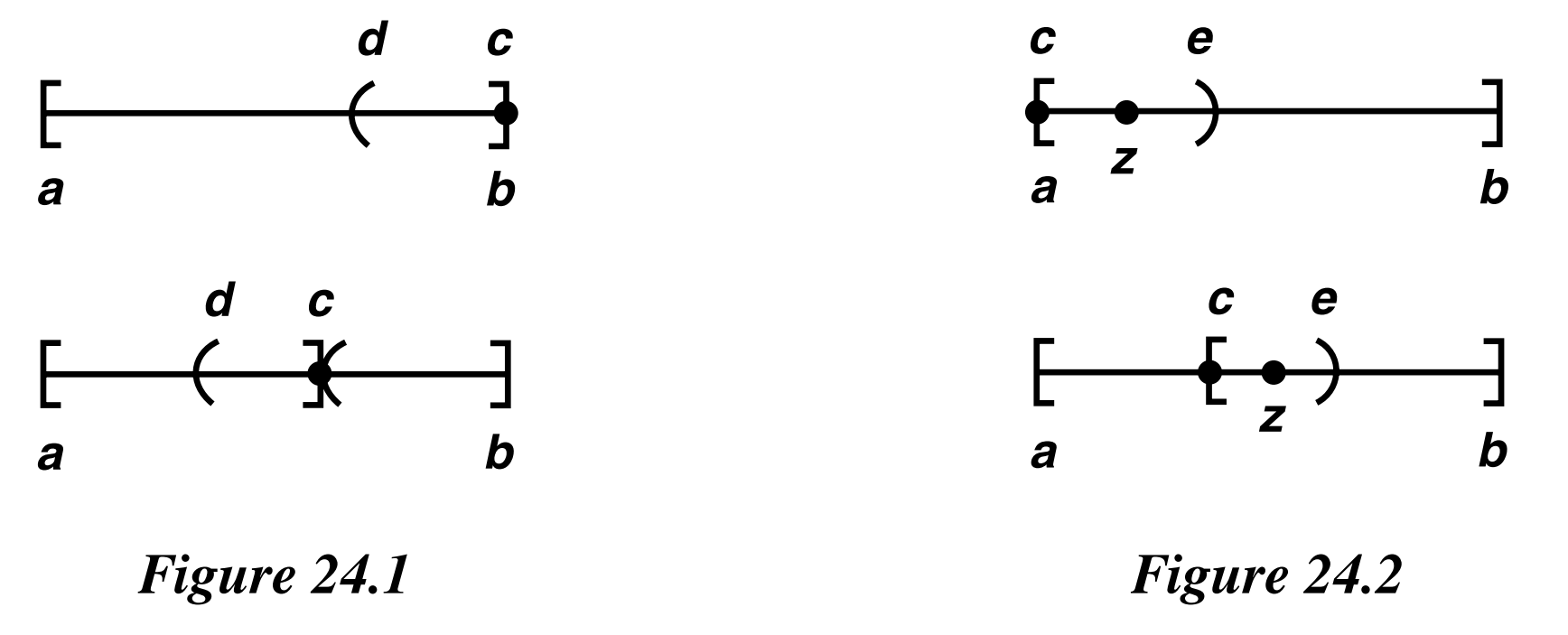
In either case, it follows from the fact that \(B_{0}\) is open in \([a, b]\) that there is some interval of the form \((d, c]\) contained in \(B_{0}\).
If \(c=b\), we have a contradiction at once, for \(d\) is a smaller upper bound on \(A_{0}\) than \(c\).
If \(c<b\), we note that \((c, b]\) does not intersect \(A_{0}\)
(because \(c\) is an upper bound on \(A_{0}\) ). Then
does not intersect \(A_{0}\). Again, \(d\) is a smaller upper bound on \(A_{0}\) than \(c\), contrary to construction. See Figure 24.1.
Case 2.
Suppose that \(c \in A_{0}\).
Then \(c \neq b\), so either \(c=a\) or \(a<c<b\).
Because \(A_{0}\) is open in \([a, b]\), there must be some interval of the form \([c, e)\) contained in \(A_{0}\).
See Figure 24.2.
Because of order property (2) of the linear continuum \(L\), we can choose a point \(z\) of \(L\) such that \(c<z<e\).
Then \(z \in A_{0}\), contrary to the fact that \(c\) is an upper bound for \(A_{0}\).
Corollary 24.2
The real line \(\mathbb{R}\) is connected and so are intervals and rays in \(\mathbb{R}\).
Theorem 24.3 : Intermediate Value Theorem
Let \(f: X \rightarrow Y\) be a continuous map, where \(X\) is a connected space and \(Y\) is an ordered set in the order topology. If \(a\) and \(b\) are two points of \(X\) and if \(r\) is a point of \(Y\) lying between \(f(a)\) and \(f(b)\), then there exists a point \(c\) of \(X\) such that \(f(c)=r\).
The intermediate value theorem of calculus is the special case of this theorem that occurs when we take \(X\) to be a closed interval in \(\mathbb{R}\) and \(Y\) to be \(\mathbb{R}\).
Proof
Assume the hypotheses of the theorem. The sets
are disjoint, and they are nonempty because one contains \(f(a)\) and the other contains \(f(b)\). Each is open in \(f(X)\), being the intersection of an open ray in \(Y\) with \(f(X)\). If there were no point \(c\) of \(X\) such that \(f(c)=r\), then \(f(X)\) would be the union of the sets \(A\) and \(B\). Then \(A\) and \(B\) would constitute a separation of \(f(X)\), contradicting the fact that the image of a connected space under a continuous map is connected.
Example
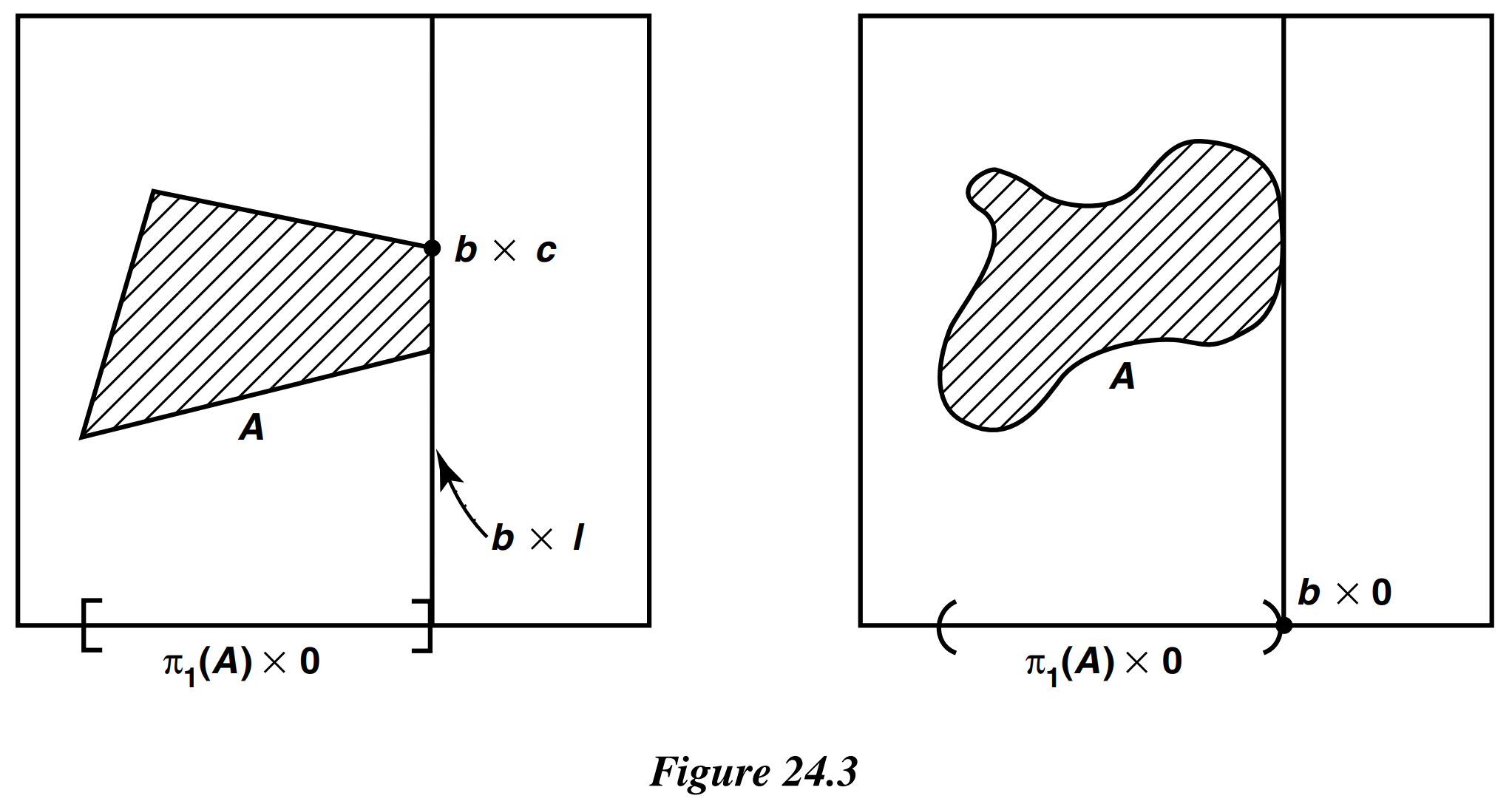
One example of a linear continuum different from \(\mathbb{R}\) is the ordered square. We check the least upper bound property. (The second property of a linear continuum is trivial to check.) Let \(A\) be a subset of \(I \times I\); let \(\pi_{1}: I \times I \rightarrow I\) be projection on the first coordinate; let \(b=\sup \pi_{1}(A)\). If \(b \in \pi_{1}(A)\), then \(A\) intersects the subset \(b \times I\) of \(I \times I\). Because \(b \times I\) has the order type of \(I\), the set \(A \cap(b \times I)\) will have a least upper bound \(b \times c\), which will be the least upper bound of \(A\). See Figure 24.3. If \(b \notin \pi_{1}(A)\), then \(b \times 0\) is the least upper bound of \(A\); no element of the form \(b^{\prime} \times c\) with \(b^{\prime}<b\) can be an upper bound for \(A\), for then \(b^{\prime}\) would be an upper bound for \(\pi_{1}(A)\).
Definition 24.2 : Path / Path Connected
Given points \(x\) and \(y\) of the space \(X\), a path in \(X\) from \(x\) to \(y\) is a continuous map \(f:[a, b] \rightarrow X\) of some closed interval in the real line into \(X\), such that \(f(a)=x\) and \(f(b)=y\). A space \(X\) is said to be path connected if every pair of points of \(X\) can be joined by a path in \(X\).
Theorem 24.4
A path-connected space \(X\) is connected.
The converse does not hold; a connected space need not be path connected.
Proof
Suppose \(X=A \cup B\) is a separation of \(X\). Let \(f:[a, b] \rightarrow X\) be any path in \(X\). Being the continuous image of a connected set, the set \(f([a, b])\) is connected, so that it lies entirely in either \(A\) or \(B\). Therefore, there is no path in \(X\) joining a point of \(A\) to a point of \(B\), contrary to the assumption that \(X\) is path connected.
Example
Define the unit ball \(B^{n}\) in \(\mathbb{R}^{n}\) by the equation
where
The unit ball is path connected.
A similar argument shows that every open ball \(B_{d}(\mathbf{x}, \epsilon)\) and every closed ball \(\bar{B}_{d}(\mathbf{x}, \epsilon)\) in \(\mathbb{R}^{n}\) is path connected.
Proof
given any two points \(\mathbf{x}\) and \(\mathbf{y}\) of \(B^{n}\), the straight-line path \(f:[0,1] \rightarrow \mathbb{R}^{n}\) defined by
lies in \(B^{n}\). For if \(\mathbf{x}\) and \(\mathbf{y}\) are in \(B^{n}\) and \(t\) is in \([0,1]\),
Example
Define punctured euclidean space to be the space \(\mathbb{R}^{n}-\{\mathbf{0}\}\), where \(\mathbf{0}\) is the origin in \(\mathbb{R}^{n}\). If \(n>1\), this space is path connected.
Proof
Given \(\mathbf{x}\) and \(\mathbf{y}\) different from \(\mathbf{0}\), we can join \(\mathbf{x}\) and \(\mathbf{y}\) by the straight-line path between them if that path does not go through the origin. Otherwise, we can choose a point \(\mathbf{z}\) not on the line joining \(\mathbf{x}\) and \(\mathbf{y}\), and take the broken-line path from \(\mathbf{x}\) to \(\mathbf{z}\), and then from \(\mathbf{z}\) to \(\mathbf{y}\).
Example
Define the unit sphere \(S^{n-1}\) in \(\mathbb{R}^{n}\) by the equation
If \(n>1\), it is path connected.
Proof
For the map \(g: \mathbb{R}^{n}-\{\mathbf{0}\} \rightarrow S^{n-1}\) defined by \(g(\mathbf{x})=\mathbf{x} /\|\mathbf{x}\|\) is continuous and surjective; and it is easy to show that the continuous image of a path connected space is path connected.
Example
The ordered square \(I_{o}^{2}\) is connected but not path connected.
Proof
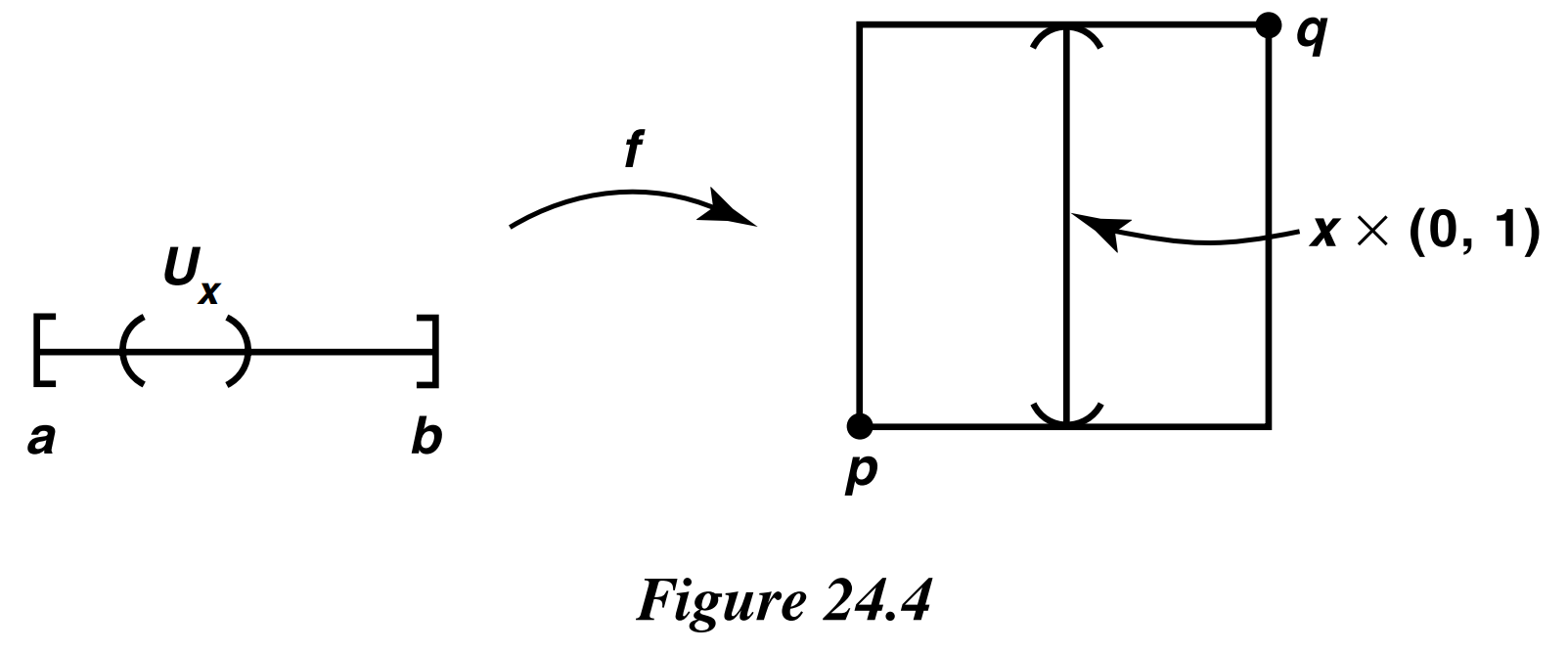
Being a linear continuum, the ordered square is connected. Let \(p=0 \times 0\) and \(q=\) \(1 \times 1\). We suppose there is a path \(f:[a, b] \rightarrow I_{o}^{2}\) joining \(p\) and \(q\) and derive a contradiction. The image set \(f([a, b])\) must contain every point \(x \times y\) of \(I_{o}^{2}\), by the intermediate value theorem. Therefore, for each \(x \in I\), the set
is a nonempty subset of \([a, b]\); by continuity, it is open in \([a, b]\). See Figure 24.4. Choose, for each \(x \in I\), a rational number \(q_{x}\) belonging to \(U_{x}\). Since the sets \(U_{x}\) are disjoint, the map \(x \rightarrow q_{x}\) is an injective mapping of \(I\) into \(\mathbb{Q}\). This contradicts the fact that the interval \(I\) is uncountable.
Example
Let \(S\) denote the following subset of the plane.
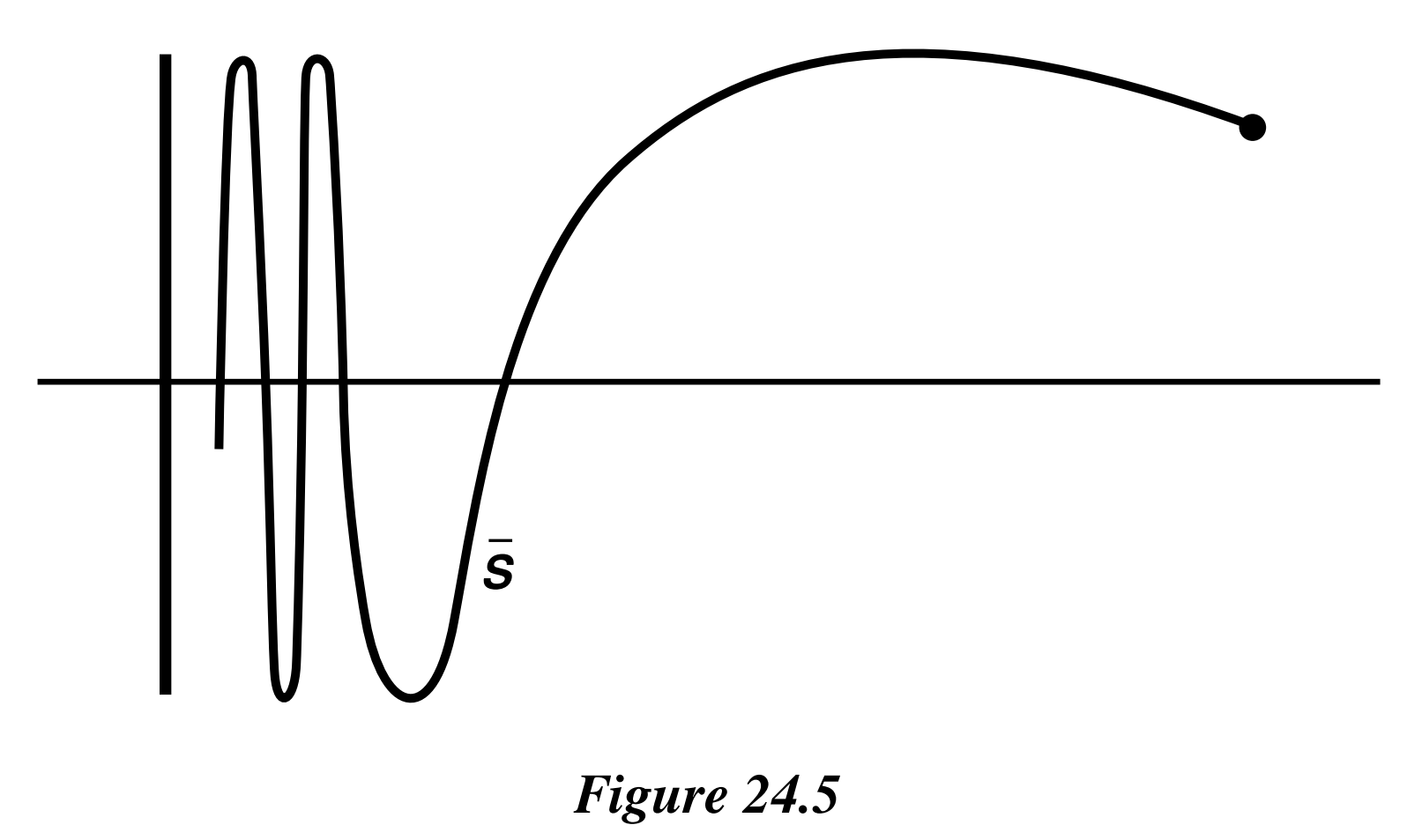
Because \(S\) is the image of the connected set \((0,1]\) under a continuous map, \(S\) is connected. Therefore, its closure \(\bar{S}\) in \(\mathbb{R}^{2}\) is also connected. The set \(\bar{S}\) is a classical example in topology called the topologist's sine curve. It is illustrated in Figure 24.5; it equals the union of \(S\) and the vertical interval \(0 \times[-1,1]\). We show that \(\bar{S}\) is not path connected.
Proof
Suppose there is a path \(f:[a, c] \rightarrow \bar{S}\) beginning at the origin and ending at a point of \(S\). The set of those \(t\) for which \(f(t) \in 0 \times[-1,1]\) is closed, so it has a largest element \(b\). Then \(f:[b, c] \rightarrow \bar{S}\) is a path that maps \(b\) into the vertical interval \(0 \times[-1,1]\) and maps the other points of \([b, c]\) to points of \(S\).
Replace \([b, c]\) by \([0,1]\) for convenience; let \(f(t)=(x(t), y(t))\). Then \(x(0)=0\), while \(x(t)>0\) and \(y(t)=\sin (1 / x(t))\) for \(t>0\). We show there is a sequence of points \(t_{n} \rightarrow 0\) such that \(y\left(t_{n}\right)=(-1)^{n}\). Then the sequence \(y\left(t_{n}\right)\) does not converge, contradicting continuity of \(f\).
To find \(t_{n}\), we proceed as follows: Given \(n\), choose \(u\) with \(0<u<x(1 / n)\) such that \(\sin (1 / u)=(-1)^{n}\). Then use the intermediate value theorem to find \(t_{n}\) with \(0<t_{n}<1 / n\) such that \(x\left(t_{n}\right)=u\).