§ 4.7. RV32I Experiment Results¶
Experiment setup · Fixed programs · Generated workloads · Compiled workloads
This report answers one question: how do the single-cycle, baseline pipeline, and advanced pipeline execute the workload groups defined in § 4.2? For FF memory, the advanced core is tested with five branch-prediction policies, so each full comparison has seven targets across three cores. The measured campaigns completed on October 14, 2026. The full Embench section is clearly labeled as a projection from older cycles; it was not rerun on this source.
Read the comparison rules, then follow the groups in § 4.2 order: fixed programs, generated families, controlled core-gap cases, and compiled workloads. The cross-group comparison brings the measured FF panels together.
Completed campaign coverage¶
All 497 current-source case/target rows completed their intended program or fixture verdict, matched the instruction oracle where applicable, and passed a structural-reference comparison at the reported clock period. They reported zero setup violations. The three broad FF campaigns also had a separate measurement phase. This counts panel rows, not unique programs: some workload/target definitions recur in more than one panel.
| § 4.2 workload group / follow-up | Current measured cases | Structural checks | Where to read the results |
|---|---|---|---|
| 22 fixed programs × 7 FF targets | 154 | 154 | Fixed programs |
| 15 generated families × 7 FF targets | 105 | 105 | Generated families |
| 23 core-gap settings × 7 FF targets | 161 | 161 | Controlled core-gap cases |
| 5 longer branch patterns × 7 FF targets | 35 | 35 | Longer branch patterns |
| Compatible advanced/two-bit FF and timed-memory pairs | 18 | 18 | Memory endpoint follow-up |
| Separate program-20 default-policy core/memory pairs | 7 | 7 | Default-policy program-20 check |
| Predictor capacity settings, advanced/two-bit | 3 | 3 | Predictor capacity |
| 2 checked-in ELF fixtures × 7 FF targets | 14 | 14 | Compiled fixtures |
| Total measured panel rows | 497 | 497 |
The full Embench projection is outside this measured total. The reduced-work Embench middle suite also has no current-source result here.
How to read the results¶
The wide tables report modeled execution ticks for the same case across
the seven FF targets. Columns Adv NT, Adv T, Adv BT, Adv 1b, and
Adv 2b mean the advanced core with static not-taken, static taken,
backward-taken, one-bit, and two-bit prediction. Single-cycle and baseline
use their only not-taken setting. Unless a section says otherwise, predictors
have 16 entries. A lower tick count means less simulated time for that
case, not less host time or a higher physical clock rate.
Current clock certificates, 2026-10-13¶
The current experiment binary's ten clock analyses were rechecked on October
14; all reported safe-under-contracts. The FF results use binary-startup
certificates; the FF configurations also have unrestricted four-state analyses. The timed
endpoints have unrestricted four-state analyses only.
| Target and endpoint | Certified ticks per CPU cycle |
|---|---|
| Single-cycle, zero-wait FF | 166 |
| Baseline five-stage, zero-wait FF | 80 |
| Advanced five-stage, zero-wait FF (all five policies) | 100 |
| Advanced five-stage, SRAM / DRAM / ROM / NOR-flash | 102 |
Ticks = completed CPU cycles × that run's period. Divide any FF table cell by its column's period to recover the exact cycle count. Periods are fixed within a run; behavioral propagation delays and memory response waits can vary with the work. The four timed endpoints share a sufficient 102-tick period because the present instruction-request ready path limits all four configurations, despite their different access sequences and response waits. These are modeled clock periods, not physical frequency measurements.
The behavioral run is checked against an instruction oracle or fixture verdict and a structural CPU reference using the same period. That reference keeps scalable storage and memory abstractions; it is not a fully expanded transistor-level machine. § 4.2 describes the execution contract and equivalence checks.
Results in brief¶
- With advanced prediction fixed to two-bit, it has the lowest modeled ticks among the three cores on 11/14 nontrap fixed programs, 14/15 generated families, 20/23 core-gap settings, and all five longer branch patterns. Baseline still wins selected independent-work cases with its shorter clock.
- The best advanced predictor changes with the branch pattern. Two-bit is a stable fixed choice in the longer branch panel, but static taken, backward-taken, or one-bit wins individual patterns.
- Timed memory changes the advanced core's cycle count as well as its clock period. The full Embench comparison below remains a projection, so it is not included in these measured conclusions.
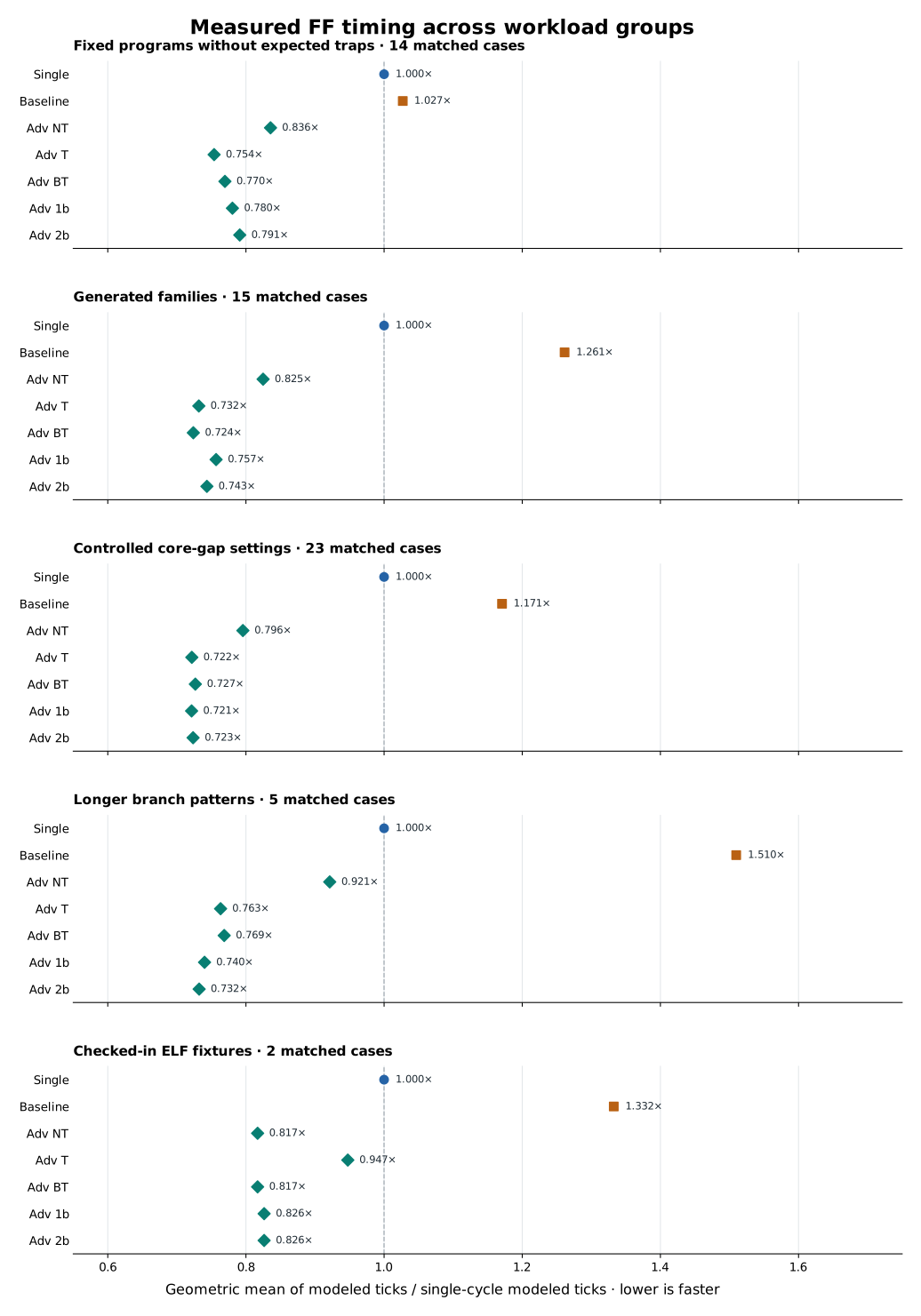
Measured FF group overview. Each point is an unweighted geometric mean of
matched casewise target ticks / single-cycle ticks; lower is faster. The
fixed-program panel excludes eight expected traps. The generated and core-gap
groups overlap, so their summaries are separate descriptions, not inputs to
one combined score. The two-fixture panel is deliberately small.
Fixed programs¶
The 22 fixed programs test instruction behavior, expected traps, and six short workloads. All 154 FF target cases completed and passed the stated checks. Programs 09–16 are expected trap or fault outcomes: their small tick totals test precise stopping, not throughput. The other 14 programs provide a short, matched performance comparison.
Modeled ticks, complete 22 × 7 FF panel:
| Case | Single | Baseline | Adv NT | Adv T | Adv BT | Adv 1b | Adv 2b |
|---|---|---|---|---|---|---|---|
| program-01 | 4,814 | 5,760 | 4,300 | 3,900 | 3,900 | 4,100 | 4,300 |
| program-02 | 5,810 | 4,000 | 3,900 | 3,900 | 3,900 | 3,900 | 3,900 |
| program-03 | 2,822 | 2,160 | 2,100 | 2,100 | 2,100 | 2,100 | 2,100 |
| program-04 | 3,984 | 4,480 | 4,000 | 3,000 | 4,000 | 4,000 | 4,000 |
| program-05 | 1,826 | 2,000 | 1,900 | 1,900 | 1,900 | 1,900 | 1,900 |
| program-06 | 1,660 | 1,600 | 1,400 | 1,400 | 1,400 | 1,400 | 1,400 |
| program-07 | 10,126 | 9,840 | 7,900 | 6,700 | 6,700 | 6,900 | 7,100 |
| program-08 | 6,972 | 7,120 | 5,900 | 5,300 | 5,300 | 5,500 | 5,700 |
| program-09 | 332 | 480 | 600 | 600 | 600 | 600 | 600 |
| program-10 | 332 | 480 | 600 | 600 | 600 | 600 | 600 |
| program-11 | 332 | 720 | 600 | 600 | 600 | 600 | 600 |
| program-12 | 498 | 800 | 700 | 700 | 700 | 700 | 700 |
| program-13 | 332 | 720 | 600 | 600 | 600 | 600 | 600 |
| program-14 | 498 | 800 | 700 | 700 | 700 | 700 | 700 |
| program-15 | 332 | 720 | 600 | 600 | 600 | 600 | 600 |
| program-16 | 498 | 960 | 900 | 900 | 900 | 900 | 900 |
| program-17 | 12,118 | 6,160 | 7,700 | 7,700 | 7,700 | 7,700 | 7,700 |
| program-18 | 10,956 | 20,960 | 7,000 | 7,000 | 7,000 | 7,000 | 7,000 |
| program-19 | 11,122 | 13,520 | 10,300 | 10,300 | 10,300 | 10,300 | 10,300 |
| program-20 | 8,466 | 11,040 | 8,500 | 5,700 | 5,700 | 5,900 | 6,100 |
| program-21 | 13,944 | 17,360 | 13,400 | 10,600 | 10,600 | 10,800 | 11,000 |
| program-22 | 10,126 | 10,320 | 8,700 | 7,500 | 7,500 | 7,700 | 7,900 |
Among the 14 nontrap programs, advanced/two-bit has the fewest ticks on 11 when comparing only single-cycle, baseline, and that fixed advanced policy; single-cycle wins two and baseline wins one. This is not a claim that two-bit is the best predictor on each program. On program 20, advanced/taken and advanced/backward-taken each need 5,700 ticks, versus 6,100 for two-bit and 8,500 for advanced/not-taken. On program 17, the baseline's 6,160 ticks beat advanced/two-bit's 7,700 because the baseline period is shorter. Program 04 is nearly tied between single-cycle (3,984) and advanced/two-bit (4,000). Including the eight tiny trap cases reverses the single/advanced geometric mean, because fixed pipeline startup costs dominate those cases; they remain in the complete table but outside the 14-program performance summary.
Memory endpoint follow-up¶
The advanced/two-bit core also ran fixed programs 19–22 with both instruction and data memory set to the same endpoint. A cell is cycles / modeled ticks; the FF column uses period 100 and timed columns use 102. All 18 selected pairs passed the oracle, structural comparison, final-state and observed handshake checks.
| Program | FF (100) | SRAM (102) | DRAM (102) | ROM (102) | NOR-flash (102) |
|---|---|---|---|---|---|
| program-19 | 103 / 10,300 | 470 / 47,940 | 648 / 66,096 | 470 / 47,940 | 403 / 41,106 |
| program-20 | 61 / 6,100 | 328 / 33,456 | 507 / 51,714 | 328 / 33,456 | 274 / 27,948 |
| program-21 | 110 / 11,000 | 558 / 56,916 | 807 / 82,314 | 558 / 56,916 | 471 / 48,042 |
| program-22 | 79 / 7,900 | 420 / 42,840 | 655 / 66,810 | — | — |
Programs 19–21 support all five endpoints. Program 22 writes data, so read-only ROM and NOR-flash were not selected for it. Both instruction and data endpoints change together; program 20 has no data-memory access and therefore isolates instruction-fetch behavior in this panel. For program 21, all five modes retire 83 instructions and reach the same final state, but FF needs 11,000 ticks, SRAM and ROM 56,916, NOR-flash 48,042, and DRAM 82,314. The timed modes share a clock period while their cycle counts differ. These small inputs do not establish a general ranking of memory technologies. Overlapping wait counters cannot be added into a single stall total.
Default-policy program-20 check¶
A separate seven-pair check used the advanced core's default not-taken policy, rather than the two-bit policy in the memory panel. Its three FF rows also occur in the complete fixed-program table. Keeping this small check separate avoids conflating predictor and memory changes.
| Core | Memory | Period | Cycles | Modeled ticks |
|---|---|---|---|---|
| single | FF | 166 | 51 | 8,466 |
| baseline | FF | 80 | 138 | 11,040 |
| advanced | FF | 100 | 85 | 8,500 |
| advanced | sram | 102 | 400 | 40,800 |
| advanced | dram | 102 | 583 | 59,466 |
| advanced | rom | 102 | 400 | 40,800 |
| advanced | nor-flash | 102 | 334 | 34,068 |
At FF timing, single-cycle takes 8,466 ticks and advanced/not-taken takes 8,500, a 34-tick near tie. Timed endpoints add request and response waits to the advanced run, not merely two ticks to each old FF cycle.
Generated families¶
The 15 generated families contribute one representative case each, run unchanged on all seven FF targets: 105/105 completed cases. The three legacy loops use their own iteration scheme; the other twelve use eight iterations, size eight and seed one, with sort and CRC32 capped at two iterations. A family name is not a claim about all of its possible parameter values.
Modeled ticks, complete 15 × 7 FF panel:
| Case | Single | Baseline | Adv NT | Adv T | Adv BT | Adv 1b | Adv 2b |
|---|---|---|---|---|---|---|---|
| dependent | 7,304 | 11,360 | 6,200 | 5,000 | 5,000 | 5,200 | 5,400 |
| alternating | 6,640 | 10,400 | 6,600 | 5,400 | 5,400 | 6,400 | 5,800 |
| nested | 36,520 | 48,240 | 35,000 | 24,200 | 24,200 | 26,000 | 25,000 |
| independent | 91,466 | 50,000 | 56,900 | 55,700 | 55,700 | 55,900 | 56,100 |
| dependency | 91,466 | 170,960 | 56,900 | 55,700 | 55,700 | 55,900 | 56,100 |
| load-use | 36,188 | 37,440 | 30,000 | 28,800 | 28,800 | 29,000 | 29,200 |
| load-scheduled | 36,188 | 32,320 | 23,600 | 22,400 | 22,400 | 22,600 | 22,800 |
| branch-pattern | 11,620 | 17,360 | 10,400 | 9,200 | 9,200 | 10,000 | 9,600 |
| branch-alias | 26,726 | 44,640 | 19,500 | 18,300 | 18,300 | 20,100 | 18,700 |
| calls | 28,220 | 34,720 | 26,800 | 25,600 | 25,600 | 25,800 | 26,000 |
| stream | 86,154 | 92,480 | 71,300 | 60,500 | 60,500 | 62,300 | 61,300 |
| pointer-chase | 64,906 | 97,600 | 64,900 | 54,100 | 54,100 | 55,900 | 54,900 |
| sort | 75,198 | 93,280 | 61,500 | 67,900 | 56,700 | 59,300 | 58,500 |
| crc32 | 136,618 | 174,320 | 123,300 | 100,100 | 101,700 | 105,700 | 103,900 |
| scan | 72,874 | 99,520 | 63,300 | 52,500 | 52,500 | 54,300 | 53,300 |
With advanced fixed to two-bit, it has the fewest ticks of the three cores
on 14/15 cases. independent is the exception: baseline takes 50,000 ticks
and advanced/two-bit 56,100. The dependency case keeps the same
single-cycle 91,466 ticks as independent, while baseline rises from 50,000
to 170,960; advanced/two-bit stays at 56,100. This is the intended
dependency/forwarding contrast. Scheduling the load-use work lowers
advanced/two-bit from 29,200 to 22,800 ticks and removes the observed 64
load-use stalls without changing the intended computation. Taken and
backward-taken often outperform two-bit on these short cases; the full table
shows every policy instead of selecting a winner after each run.
Controlled core-gap cases¶
The core-gap preset varies one pressure at a time while holding each case identical across the seven FF targets: 23 settings, 161/161 completed cases. Some settings intentionally repeat a generated-family case. These are controlled diagnostics, so their rows must not be counted as 23 independent real programs. Sort and CRC32 again use two iterations; the other whole-program cases use eight iterations, size eight and seed one.
Dependencies and load scheduling¶
Modeled ticks, eight controlled settings:
| Case | Single | Baseline | Adv NT | Adv T | Adv BT | Adv 1b | Adv 2b |
|---|---|---|---|---|---|---|---|
| independent-short | 14,774 | 10,240 | 9,300 | 9,500 | 9,500 | 9,300 | 9,300 |
| independent-long | 91,466 | 50,000 | 56,900 | 55,700 | 55,700 | 55,900 | 56,100 |
| dependency-d1 | 91,466 | 170,960 | 56,900 | 55,700 | 55,700 | 55,900 | 56,100 |
| dependency-d2 | 91,466 | 89,680 | 56,900 | 55,700 | 55,700 | 55,900 | 56,100 |
| dependency-d4 | 91,466 | 50,000 | 56,900 | 55,700 | 55,700 | 55,900 | 56,100 |
| dependency-d8 | 91,466 | 50,000 | 56,900 | 55,700 | 55,700 | 55,900 | 56,100 |
| load-use | 36,188 | 37,440 | 30,000 | 28,800 | 28,800 | 29,000 | 29,200 |
| load-scheduled | 36,188 | 32,320 | 23,600 | 22,400 | 22,400 | 22,600 | 22,800 |
The distance-one dependency makes baseline take 2,137 cycles / 170,960 ticks while advanced/two-bit takes 561 / 56,100. At distance four or eight, baseline falls to 625 / 50,000 and beats advanced/two-bit in ticks despite using more cycles, because its period is 80 rather than 100. On the immediate load-use case, advanced/two-bit takes 292 cycles / 29,200 ticks and records 64 load-use stalls. Scheduling the same work takes 228 / 22,800 with zero such stalls. These pairs identify the intended hazard; they do not isolate every cause in a compiled program.
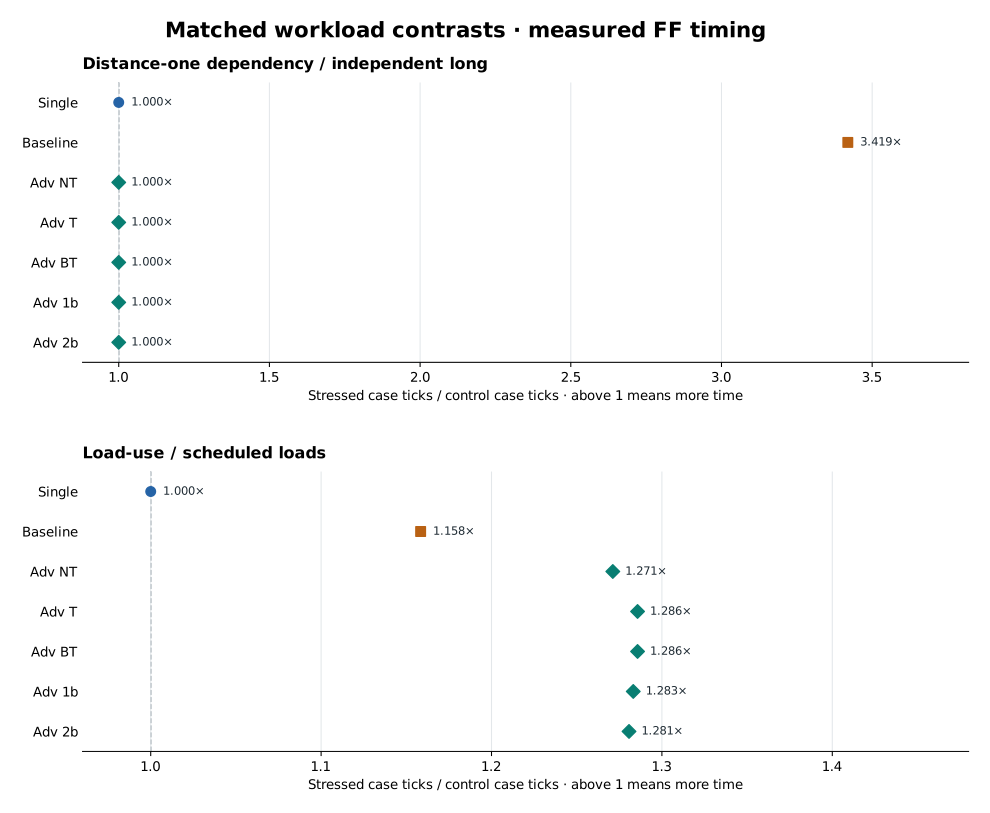
Matched controlled contrasts. A value above one means the stressed case takes more modeled ticks than its paired control. Both panels show the three cores and every advanced prediction mode; they compare selected workload settings rather than attributing all costs in compiled programs.
Branch direction, aliasing, and training¶
Modeled ticks, nine controlled settings:
| Case | Single | Baseline | Adv NT | Adv T | Adv BT | Adv 1b | Adv 2b |
|---|---|---|---|---|---|---|---|
| branch-taken | 10,956 | 17,040 | 10,800 | 8,000 | 9,600 | 8,400 | 8,800 |
| branch-not-taken | 12,284 | 17,680 | 10,000 | 10,400 | 8,800 | 9,000 | 9,200 |
| branch-alternating | 11,620 | 17,360 | 10,400 | 9,200 | 9,200 | 10,000 | 9,600 |
| branch-bursts | 12,284 | 17,680 | 10,000 | 10,400 | 8,800 | 9,000 | 9,200 |
| branch-irregular | 11,454 | 17,280 | 10,500 | 8,900 | 9,300 | 9,500 | 9,900 |
| alias-spacing8 | 16,102 | 24,160 | 13,100 | 11,900 | 11,900 | 10,700 | 11,100 |
| alias-spacing16 | 26,726 | 44,640 | 19,500 | 18,300 | 18,300 | 20,100 | 18,700 |
| branch-body-training0 | 9,296 | 14,720 | 9,400 | 6,600 | 8,200 | 7,000 | 7,400 |
| branch-body-training32 | 9,296 | 14,720 | 9,400 | 6,600 | 8,200 | 6,600 | 6,600 |
Changing branch direction alters which advanced policy wins. The body-window training pair measures the same branch body after zero or 32 real prefix iterations. Advanced/two-bit drops from 74 cycles / 7,400 ticks to 66 / 6,600, and observed next-PC misses fall from five to one. The training prefix is executed and verified but lies outside the measured body; these rows are not whole-program time comparisons.
Calls, memory kernels, sort, and CRC32¶
Modeled ticks, six controlled settings:
| Case | Single | Baseline | Adv NT | Adv T | Adv BT | Adv 1b | Adv 2b |
|---|---|---|---|---|---|---|---|
| calls | 28,220 | 34,720 | 26,800 | 25,600 | 25,600 | 25,800 | 26,000 |
| stream | 86,154 | 92,480 | 71,300 | 60,500 | 60,500 | 62,300 | 61,300 |
| pointer-chase | 64,906 | 97,600 | 64,900 | 54,100 | 54,100 | 55,900 | 54,900 |
| scan | 72,874 | 99,520 | 63,300 | 52,500 | 52,500 | 54,300 | 53,300 |
| sort | 75,198 | 93,280 | 61,500 | 67,900 | 56,700 | 59,300 | 58,500 |
| crc32 | 136,618 | 174,320 | 123,300 | 100,100 | 101,700 | 105,700 | 103,900 |
This last cluster tests calls and data-heavy kernels under the same seven targets. It supplies workload diversity to the 23-case panel, but a two-iteration sort or CRC32 row is still only its declared generated input.
Longer branch patterns¶
The separate 64-iteration branch-pattern campaign extends the five direction patterns beyond the short core-gap cases. All 35 cases completed with 16 predictor entries and the same FF clocks. Each cell below is modeled ticks.
| Target | taken | not-taken | alternating | bursts | irregular |
|---|---|---|---|---|---|
| Single | 76,028 | 86,652 | 81,340 | 81,340 | 81,008 |
| Baseline | 120,080 | 125,200 | 122,640 | 122,640 | 122,480 |
| Adv NT | 78,000 | 71,600 | 74,800 | 74,800 | 75,000 |
| Adv T | 52,800 | 72,000 | 62,400 | 62,400 | 61,800 |
| Adv BT | 65,600 | 59,200 | 62,400 | 62,400 | 62,600 |
| Adv 1b | 53,200 | 59,400 | 68,800 | 57,600 | 62,600 |
| Adv 2b | 53,600 | 59,600 | 62,800 | 59,200 | 62,600 |
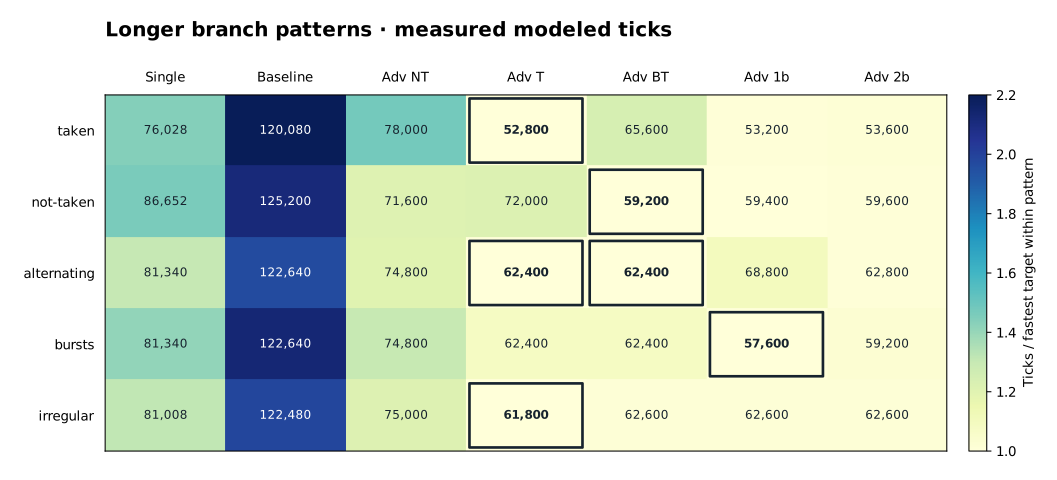
Longer branch patterns, 64 iterations each. Cell labels are absolute modeled ticks. Color shows each value divided by the fastest target in the same pattern; outlines mark the fastest value or ties. Compare targets within a row, since branch patterns can execute different amounts of work.
Advanced/two-bit is faster than single-cycle and baseline on all five matched patterns, yet it is not the fastest advanced policy on every pattern. Taken wins always-taken and irregular; backward-taken wins always-not-taken; taken and backward-taken tie on alternating; one-bit wins bursts. Two-bit remains within 2.8% of each pattern's best and has the lowest unweighted geometric-mean ticks across these five advanced-policy rows. That is a result for these patterns, not a universal predictor choice.
Predictor capacity¶
A separate 64-iteration aliasing case varied only the advanced/two-bit predictor's entry count, at the same 100-tick FF period:
| Entries | Cycles | Modeled ticks | Next-PC misses |
|---|---|---|---|
| 8 | 1,363 | 136,300 | 67 |
| 16 | 1,363 | 136,300 | 67 |
| 32 | 1,239 | 123,900 | 5 |
For this spacing-16 address pattern, 32 entries reduce modeled time by 9.1% relative to 8 or 16. This capacity experiment is not part of the seven-target policy sweep and does not establish a general size optimum.
Compiled fixtures¶
The two checked-in ELF fixtures test external loading and compiler-produced RV32I code without a full Embench workload. Both passed their verdict, oracle and structural checks on all seven FF targets: 14/14 measured cases.
Modeled ticks, complete 2 × 7 FF panel:
| Case | Single | Baseline | Adv NT | Adv T | Adv BT | Adv 1b | Adv 2b |
|---|---|---|---|---|---|---|---|
| self-check.elf | 3,154 | 4,480 | 2,600 | 3,200 | 2,600 | 2,600 | 2,600 |
| compiled.elf | 10,624 | 13,280 | 8,600 | 9,400 | 8,600 | 8,800 | 8,800 |
Advanced/two-bit has the fewest ticks among the three fixed core choices on both small fixtures. These images are dominated by startup and control work; they do not measure the full applications in the next section. The reduced-work Embench middle suite has no current-source result in this report.
Full Embench: conditional clock-only projection¶
The previously completed full campaign covered 19 Embench workloads × seven targets with original verifiers and instruction-oracle checks, but without structural-reference checks. It used an older source snapshot. These full workloads were not rerun for this report. Each value below is its historical cycle count multiplied by the current FF period (166 for single-cycle, 80 for baseline, 100 for advanced). Every cell is therefore projected ticks, not a current-source measurement.
Conditional projected ticks, all 19 × 7 target cells:
| Workload | Single | Baseline | Adv NT | Adv T | Adv BT | Adv 1b | Adv 2b |
|---|---|---|---|---|---|---|---|
| aha-mont64 | 1,896,633,332 | 1,339,124,800 | 1,401,946,600 | 1,235,783,200 | 1,256,469,800 | 1,238,070,400 | 1,231,201,600 |
| crc32 | 1,017,653,538 | 1,597,307,680 | 735,689,100 | 700,703,900 | 700,703,300 | 700,737,500 | 700,703,900 |
| cubic | 5,027,784,760 | 5,711,966,960 | 4,259,061,500 | 3,750,531,700 | 3,729,660,900 | 3,713,034,300 | 3,651,384,700 |
| edn | 12,472,462,456 | 15,284,812,640 | 11,191,020,600 | 9,273,386,400 | 8,905,101,600 | 8,363,109,800 | 8,351,850,000 |
| huffbench | 447,196,032 | 459,991,280 | 336,573,700 | 321,545,700 | 292,274,300 | 296,350,500 | 294,047,500 |
| matmult-int | 4,898,069,538 | 5,954,113,680 | 4,417,715,700 | 3,656,464,300 | 3,601,549,500 | 3,716,036,700 | 3,640,760,500 |
| minver | 2,116,768,754 | 2,325,192,880 | 1,798,753,100 | 1,616,513,900 | 1,576,249,300 | 1,530,637,900 | 1,522,743,700 |
| nbody | 4,522,991,210 | 5,243,280,880 | 3,886,884,100 | 3,365,917,300 | 3,293,952,300 | 3,313,207,300 | 3,282,622,900 |
| nettle-aes | 798,011,800 | 470,050,720 | 504,453,000 | 504,609,000 | 495,713,000 | 499,820,600 | 494,087,000 |
| nettle-sha256 | 680,434,166 | 417,576,640 | 420,662,700 | 417,711,700 | 415,807,100 | 416,853,900 | 416,096,100 |
| nsichneu | 371,628,350 | 524,960,720 | 337,960,800 | 417,551,200 | 337,717,400 | 340,671,400 | 335,496,400 |
| picojpeg | 870,133,156 | 945,516,160 | 612,915,800 | 559,175,000 | 576,847,400 | 553,709,000 | 551,999,400 |
| qrduino | 1,001,327,106 | 1,213,551,200 | 794,840,600 | 754,335,200 | 737,435,600 | 755,631,000 | 731,785,000 |
| sglib-combined | 493,939,972 | 552,543,280 | 382,867,700 | 406,356,100 | 380,880,500 | 369,897,100 | 363,784,700 |
| slre | 420,608,642 | 458,624,160 | 310,469,600 | 345,258,400 | 310,448,200 | 306,161,600 | 296,970,200 |
| st | 2,970,614,986 | 3,439,302,960 | 2,545,823,900 | 2,245,396,700 | 2,159,090,100 | 2,185,002,500 | 2,148,420,900 |
| statemate | 279,640,612 | 241,864,160 | 193,824,300 | 187,538,500 | 191,455,500 | 188,702,900 | 185,562,700 |
| ud | 1,124,021,026 | 1,174,970,400 | 896,616,100 | 905,194,500 | 865,849,100 | 886,851,300 | 853,131,100 |
| wikisort | 1,047,470,624 | 1,131,400,320 | 895,912,600 | 814,907,400 | 792,668,600 | 764,454,400 | 755,291,600 |
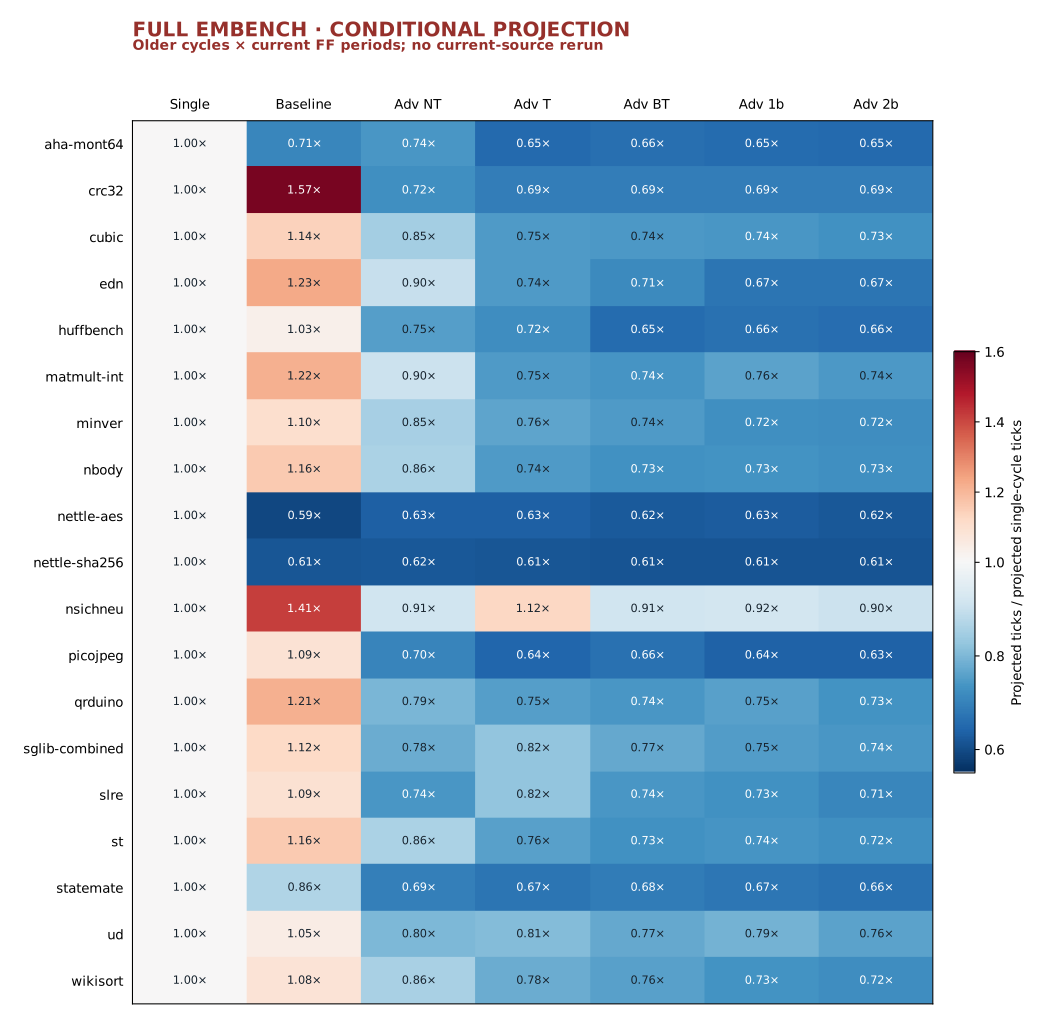
Conditional full Embench projection, not a current-source measurement. Each
cell shows projected target ticks / single-cycle ticks for that workload;
the single-cycle reference is visible at 1.0. The table above gives all
projected tick counts. These relative colors are conditional on the older
cycle counts remaining unchanged.
If the old cycle counts were unchanged, advanced/two-bit would have the
fewest projected ticks among the three fixed core choices on 18/19 workloads;
baseline would lead nettle-aes. The unweighted geometric-mean projected
ratios to advanced/two-bit are 1.425× for single-cycle and 1.488× for
baseline. This arithmetic is conditional and is not a newly validated
full Embench comparison, an official normalized Embench score, or evidence
that the current source retains the old cycle counts. The full run includes
startup, in-program warmup, repetitions and verification; the small checked-in
fixtures and reduced middle suite do not replace it.
Cross-group comparison¶
For a consistent three-core comparison on measured FF results, hold
advanced prediction at two-bit and compare exactly the same cases within
each group. The ratios are unweighted geometric means of
other core ticks / advanced two-bit ticks; values above one favor advanced.
The winner counts also compare just those three fixed targets. The eight tiny
expected-trap programs are omitted from the first performance summary, though
their results remain in the fixed-program table.
| Measured group | Matched cases | Lowest ticks: single / baseline / advanced 2b | Single / advanced 2b | Baseline / advanced 2b |
|---|---|---|---|---|
| Fixed programs excluding expected traps | 14 | 2 / 1 / 11 | 1.264× | 1.298× |
| Generated families | 15 | 0 / 1 / 14 | 1.345× | 1.696× |
| Core-gap settings | 23 | 0 / 3 / 20 | 1.382× | 1.618× |
| Longer branch patterns | 5 | 0 / 0 / 5 | 1.366× | 2.062× |
The advanced pipeline usually compensates for its 100-tick period by saving cycles through forwarding and prediction. The baseline's 80-tick period can still win on independent work, while dependency and branch stalls can erase that clock advantage. Across these groups, there is no single winner for every workload or advanced predictor policy. Groups overlap in generated definitions, so these four ratios are separate descriptions, not four independent benchmark scores to average together. Timed-memory rows change the endpoint and are not part of this FF-only core comparison.
Interpretation and evidence limits¶
The measured tables above record the selected inputs and target settings, not every possible RV32I program, predictor size, or memory/core pairing. Single-cycle and baseline were tested only with FF memory; timed-memory results cover advanced/two-bit plus the separate default-policy program-20 check. The structural reference checks an affordable CPU datapath and scalable memory abstractions. It does not turn a finite campaign into a proof of every implementation state.
All displayed times are simulated ticks. Host execution seconds were recorded with only one measurement and no host warmup, so they are not a stable host-speed ranking. The full Embench section remains a projection until its complete ELFs are rerun on the current source. Changes to circuitry, delay tables, memory response rules, predictor capacity, or clock contracts require new certificates and, where cycles can change, new program results.